
TOGAF Flight Plans Crash Into AI Reality Check
TOGAF works fine until generative AI explodes your carefully planned architecture like Apollo 13's oxygen tank.
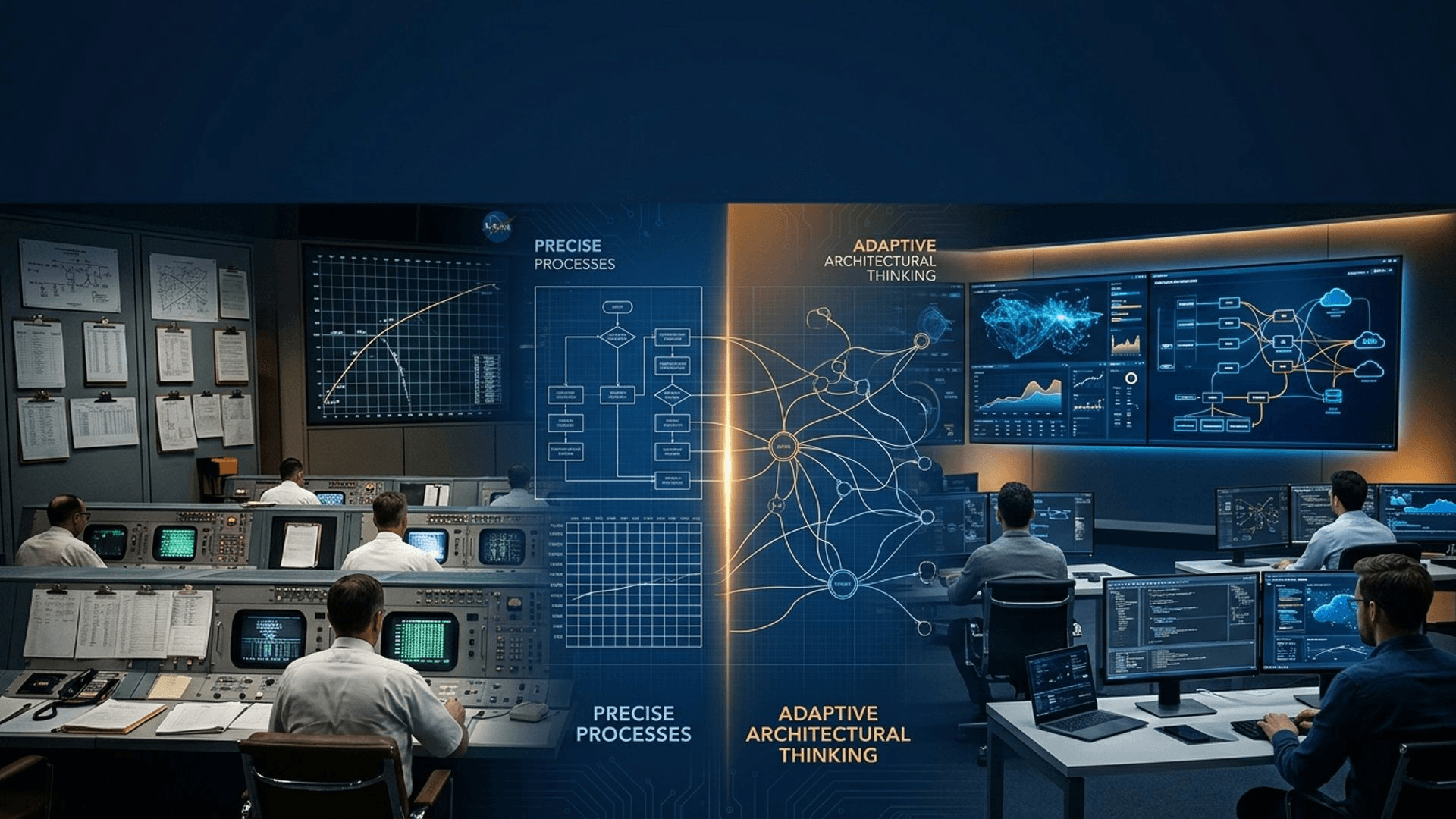
Your TOGAF Flight Plan Did Not Survive the AI Oxygen Tank
The Apollo 13 mission (1970) had the best available framework for a lunar mission. It had been validated through eight prior missions. It covered every known scenario with precision. Then the oxygen tank exploded and the flight plan became reference material rather than operational guidance.
Mission Control did not abandon aerospace engineering. They applied those same engineering principles to a situation the original procedures had never anticipated. The CO2 scrubber fix, built from duct tape and a sock, worked because the engineers understood why the original system worked, not just how to follow its steps. They knew the principles well enough to extend them when the process steps ran out.
Enterprise architects in 2026 are living the Apollo 13 moment. TOGAF is the flight plan. Generative AI is the oxygen tank.
TOGAF's core principles are not the problem. The ADM's vocabulary for three specific phases is. Enterprise architects who understand which phases and why are the ones getting AI programs into production. The ones who either abandon the framework or refuse to extend it are not.
What TOGAF Actually Gets Right
Before naming what the framework misses, it is worth being precise about what it gets right. Because the "TOGAF is dead" discourse that surfaces every time a new technology wave arrives is usually wrong for the same reason it was wrong during cloud, mobile, and DevOps: the people declaring the framework dead are criticizing its process steps, not its principles. And the principles are not the problem.
TOGAF's enduring value is not the ten-phase ADM cycle. It is the architectural thinking the cycle was designed to enforce. Strategic alignment before technical decisions: the discipline of asking which business capability an AI initiative will actually strengthen before funding the initiative. Holistic system views rather than siloed solutions: the discipline of modeling how an AI change in the Application Architecture affects the Data Architecture, the Business Architecture, and the Technology Architecture simultaneously. Governance that enables rather than constrains: the discipline of building review mechanisms that catch expensive mistakes early rather than discovering them in production.
These principles have not aged. If anything, they are more important for AI programs than they were for the ERP deployments and cloud migrations TOGAF was originally built around. The failure pattern most enterprise AI programs are currently running is the exact failure pattern TOGAF was designed to prevent: technical decisions made before business alignment, point solutions that create integration debt, and deployment without governance that leaves audit trails empty when regulators arrive.
TOGAF 10 (2022) and the 2025 Enterprise Architecture Edition added genuine value with updated guidance for AI adoption and cloud-native patterns. But updating guidance within existing phases is different from adding the vocabulary the phases are missing. The framework can handle strategic AI decisions. It cannot yet articulate the technical artifacts that distinguish successful AI deployments from expensive proof-of-concept collections.
Where the ADM's Vocabulary Runs Out
Gap 1: Phase C Has No Sublayer for Intelligence Architecture
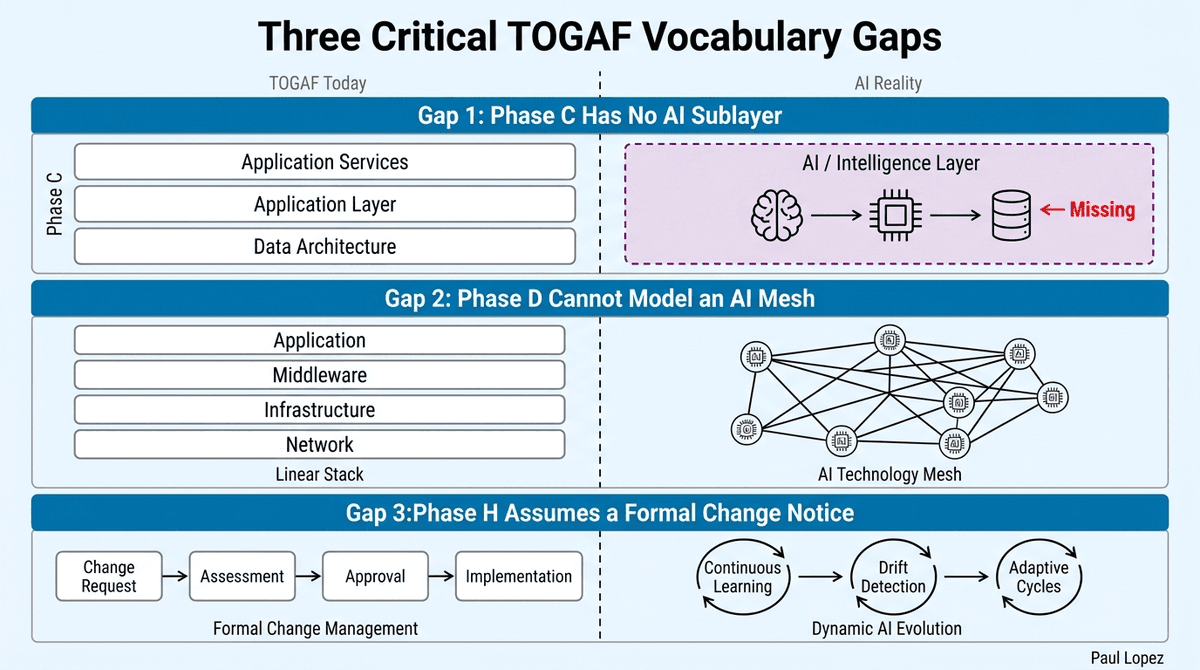
Phase C of the ADM covers Information Systems Architecture, which splits into Data Architecture and Application Architecture. For three decades, this split was sufficient. Data describes the information the system operates on. Application describes the software that processes it. The two layers together produced a complete picture of how enterprise information systems work.
Generative AI broke this model cleanly. When you deploy Claude, GPT-5.5, or Gemini in an enterprise context, the system prompt is not data and it is not an application. It is behavioral contract: a specification of how the model will interpret every interaction that follows. It determines the model's persona, its constraints, its decision boundaries, and its escalation logic. It is, functionally, the most important architectural artifact in the deployment. And TOGAF Phase C has no home for it.
It applies to context window management: how an enterprise manages the model-specific context boundary, now reaching roughly a million tokens in leading frontier models, that determines how much conversation history, retrieved content, tool output, and source material the model can consider in a single interaction. These are architectural decisions with direct business consequences. A misconfigured system prompt in a healthcare prior authorization agent is a compliance event. A poorly designed RAG architecture in a financial services advisory tool is a hallucination risk. Phase C's existing sublayers have no artifacts for capturing, reviewing, or governing any of them.
The practitioners who are filling this gap today are doing so through context architecture as a discipline: treating the system prompt, the RAG pipeline, and the context window strategy as first-class architectural artifacts with the same governance rigor as a database schema or an API contract. They are building what should be the missing Phase C sublayer: Intelligence Architecture, sitting alongside Data Architecture and Application Architecture.
Claude's enterprise deployment model explicitly treats the system prompt as a governed artifact. The Claude Partner Network's reference architecture guidance and the Claude Certified Architect credential both reflect this, making system prompt governance a defined architectural competency. This is an AI vendor recognizing the Phase C gap and building practitioner tooling around it before the framework caught up.
Gap 2: Phase D Cannot Model a Nondeterministic Technology Stack
Phase D covers Technology Architecture: the infrastructure, platforms, and technical components that support the application layer. For deterministic systems, Phase D produces reliable architecture. If you deploy a database at a specified version on specified hardware with specified configuration, it behaves predictably. The architecture document you write in Phase D describes reality for as long as that configuration holds.
Large language models are not deterministic systems. The same input does not reliably produce the same output. Model versions update on schedules the enterprise does not control and is not always notified about. Token consumption varies by query complexity in ways that aggregate budget estimates routinely undercount. Latency at inference time depends on provider infrastructure load that is invisible to the enterprise architecture team. Phase D's existing artifacts, reference models, platform specifications, and infrastructure blueprints, were built for a technology stack that behaves the same way every time. The technology stack that underpins a GenAI deployment does not.
The token economics of AI systems require architectural consideration at the Phase D level, not just operational monitoring after deployment. Failure patterns in AI systems cascade differently than in traditional applications, demanding new architectural thinking about graceful degradation and error handling.
GPT-5.5's reasoning-token economics, GPT-5.4 mini and GPT-5.4 nano's lower-latency cost profiles, and the behavioral differences across GPT-5-class models represent Phase D decisions with material cost and performance implications. An enterprise that standardizes on GPT-5.5 for complex reasoning, GPT-5.4 mini for high-volume application workflows, and GPT-5.4 nano for classification or summarization is not merely choosing model names; it is defining a technology architecture with different inference costs, latency characteristics, context-window assumptions, tool-use behavior, and failure modes. Enterprises that model their AI technology architecture on one GPT-5 model and then shift traffic to another for budget, quota, or latency reasons can learn this gap in production rather than in Phase D. The Phase D artifact that is missing is a model economics sheet: a living document that tracks inference cost, latency profile, context window limits, reasoning-token behavior, tool-use constraints, and version-to-version behavioral change commitments for each model in the enterprise AI stack.
Gap 3: Phase H Assumes Change Arrives With a Change Notice
Phase H, Architecture Change Management, is where TOGAF handles the ongoing reality that architectures do not stay static. Business conditions change. Technology evolves. Phase H provides the governance cycle that determines when a change is significant enough to trigger a new ADM iteration. It is a reactive mechanism, designed to respond to announced changes: a new regulatory requirement, a vendor platform upgrade, a business merger.
AI models change without announcement. OpenAI updated GPT-5 in ways that changed output behavior without issuing formal change notices to enterprise customers. Anthropic regularly updates Claude's underlying capabilities, safety behaviors, and context handling. Google's Gemini models iterate continuously. None of these updates arrive with the change notice that Phase H was designed to process. The architecture you documented in your last ADM cycle may not describe the system currently running in production. And the gap between documented architecture and actual behavior grows every time a model provider ships an update.
This is not a criticism of the model providers. Continuous improvement is the right operational model for AI systems. It is a gap in the governance framework. Phase H's trigger mechanism, waiting for a formal change to arrive, is the wrong posture for a technology component that changes continuously without notification. What Phase H needs for AI programs is a continuous validation loop: a monitoring capability that detects when model behavior has drifted from the architecture specification, rather than waiting for someone to report a problem.
The practitioners who are solving this today are treating evaluation not as a pre-deployment gate but as a continuous architecture validation process. Behavioral drift detection is the new Phase H.
Google's Agent-to-Agent (A2A) protocol, released April 2025 and now co-governed with MCP under the Linux Foundation's Agentic AI Foundation, introduced a new agent-to-agent communication layer that fundamentally changes multi-agent topology. Enterprise architecture teams that had documented their agent architectures before A2A's emergence found their Phase C and Phase D artifacts obsolete within weeks. Phase H had no trigger for it because A2A was not a change to an existing system. It was a new architectural primitive that rewrote assumptions.
Where the New AI Skills Map to the ADM
The three ADM gaps described above are not abstract. Each one corresponds to a specific architectural competency that production AI programs require and that TOGAF's current phase vocabulary cannot capture.
Skill 1, the ability to write precise behavioral specifications for AI agents, is the competency that fills Phase C's missing Intelligence Architecture sublayer. A system prompt is a specification. A RAG pipeline design is a specification. Treating these artifacts with the same rigor as a functional requirements document is the architectural discipline that Phase C needs and currently has no home for.
Skill 3, multi-agent orchestration design, is the Phase C Application Architecture competency that TOGAF practitioners will recognize as familiar territory but find the vocabulary inadequate. Designing a planner agent that coordinates three sub-agents across different tool contexts is an application architecture decision. The orchestration topology, the failure handling between agents, the trust boundaries between agent roles: these are Phase C concerns. They need Phase C artifacts that do not yet exist in the standard.
Skill 5, trust and security design for AI systems, maps directly to the Preliminary Phase and the governance arc that runs through every ADM phase. Designing guardrails, defining human-in-the-loop checkpoints, and distinguishing which AI decisions are reversible from which are not: these are the governance design decisions that determine whether an AI program survives a regulatory examination. TOGAF's Preliminary Phase was always about establishing governance before architecture begins. That principle has never been more important.
Skill 6, context architecture, is the name for what Phase C's Intelligence Architecture sublayer actually contains. System prompt governance, retrieval architecture, context window strategy, and knowledge freshness requirements are the four artifacts that context architecture produces. Adding them to Phase C does not require replacing TOGAF. It requires extending it.
What Enterprise Architects Should Do Now
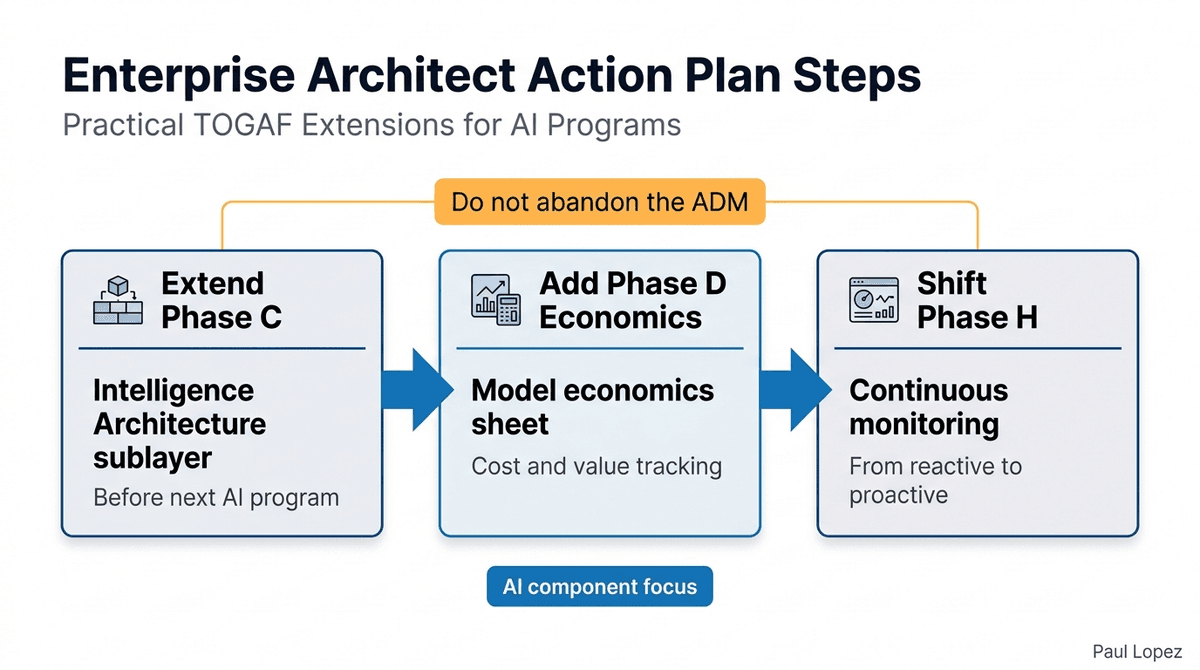
Do not abandon the ADM. The practitioners who are discarding TOGAF because it does not natively handle AI are solving the wrong problem. The ADM phases that work (Phase A vision, Phase B business architecture, Phase E opportunities, Phase F migration planning) are exactly where AI programs fail most often: because teams skip them. Use the framework for what it does well. The strategic alignment discipline that TOGAF enforces is more critical for AI programs than for traditional software deployments, because the failure costs are higher and the success patterns are less established.
Extend Phase C before starting your next AI program. Add an Intelligence Architecture sublayer to your Phase C deliverables. The minimum viable version includes three artifacts: a system prompt governance document (who can change it, under what process, with what review), a retrieval architecture design (what knowledge sources, what freshness, what fallback), and a context strategy document (how the application manages the context window boundary across interaction types). These three artifacts cost almost nothing to produce early and are expensive to reconstruct after deployment.
Add a model economics sheet to Phase D. Before finalizing technology architecture for any AI program, produce a one-page model economics sheet covering: inference cost per thousand tokens at expected volume, latency profile at P50/P95, context window limits and the cost implications of approaching them, and the model provider's change notification policy (or its documented absence). This artifact does not exist in TOGAF today. It should exist in your architecture repository. The enterprises that are controlling AI program costs are the ones that modeled the economics architecturally before they discovered them operationally.
Shift Phase H from reactive to continuous for AI components. Any AI system in production needs a behavioral drift monitoring capability, not just a change management gate. What this looks like in practice: a small evaluation harness that runs a defined set of test prompts against the production model on a scheduled basis and alerts when output behavior deviates beyond a defined threshold. This is not a massive investment. It is a Phase H extension that acknowledges the technology has changed. The alternative is discovering that your documented architecture no longer matches your running system when a user reports unexpected behavior.
The Mission Plan Changed
The Apollo 13 crew got home because Gene Kranz and his team understood aerospace engineering well enough to apply it to a situation the original procedures had never anticipated. They did not need a new framework. They needed to understand their existing framework at the level of principles rather than steps, so that when the steps ran out, the principles still guided the decisions.
Enterprise architects applying TOGAF to AI programs are in the same position. The framework's principles are not optional and they are not outdated. Strategic alignment before technical decisions. Holistic views over siloed solutions. Governance that enables rather than constrains. These are the principles that separate AI programs that reach production from AI programs that accumulate technical debt until someone cancels them.
The vocabulary gaps in Phases C, D, and H are real. They are also fillable. Intelligence Architecture as a Phase C sublayer, model economics as a Phase D artifact, and continuous behavioral validation as a Phase H extension: none of these require a TOGAF rewrite. They require enterprise architects who understand why the framework works well enough to extend it where it runs silent.
The mission did not fail. The mission plan changed. There is a difference, and knowing the difference is the job.
References
[1] The Open Group. (2022). "TOGAF Standard, Version 10 Enterprise Edition."
[2] Henderson, M. (2024). "Enterprise Architecture in the Age of AI." Open Group Blog, March 2024.
[3] Enterprise AI Governance Survey. (2024). Deloitte Digital, Q2 2024 Report.
[4] McKinsey Global Institute. (2024). "The Economics of Enterprise AI: Hidden Costs and Optimization Strategies."
[5] Gartner Research. (2024). "Nondeterministic Systems in Enterprise Architecture: A New Paradigm."
[6] Google Cloud. (2024). "Agent-to-Agent Communication Protocol: Enterprise Implementation Guide."
[7] Anthropic. (2024). "Model Context Protocol: Technical Specification and Enterprise Use Cases."
[8] MIT Technology Review. (2024). "The Complexity Crisis: Why Multi-Agent AI Systems Break Traditional Architecture."
[9] Stanford HAI. (2024). "Prompt Engineering as Software Engineering: Governance and Best Practices."
[10] SANS Institute. (2024). "Security Implications of Large Language Model Integration in Enterprise Systems."
[11] Compliance Week. (2024). "Auditing AI: How Regulated Industries Navigate Explainability Requirements."
[12] Harvard Business Review. (2024). "When AI Vendors Control Your Architecture: Managing Third-Party Model Dependencies."
[13] IEEE Software. (2024). "Model Drift Detection and Management in Production AI Systems."
[14] Forrester Research. (2024). "The AI Vendor Lock-in Crisis: Strategic Considerations for Enterprise Architects."