
Why AI Pipelines Fail and Graphs Solve It
Pipelines map where you *are*; graphs map where you need to *go* — and most enterprise AI teams are still drawing the wrong map.
Your AI Pipeline Is Already the Wrong Abstraction
Enterprise AI teams default to pipelines because pipelines are familiar. Graph engineering is what the problem actually looks like.
In 1931, Harry Beck was an engineering draughtsman working for London Underground. On his own time, without anyone asking him to, he redesigned the map of the tube system. The existing map was geographically accurate. Stations sat where they actually existed, lines curved and bent to match real track routes, distances between stations reflected real distances. It was technically correct in every measurable way. It was also nearly impossible to use for navigation.
Beck's redesign discarded geographic accuracy entirely. Stations were evenly spaced regardless of real-world distance. Lines ran only at 45 or 90 degree angles regardless of actual track direction. The Thames became a gentle curve as a simple orientation reference. Interchange stations, the nodes where multiple lines converged, were given visual prominence. In his own words, Beck recognized that "to the passenger, it does not matter where the stations are geographically; what matters is the order of the stations and the connections between lines." London Underground trialed the redesign in January 1933. They distributed 700,000 copies. It was an immediate success.
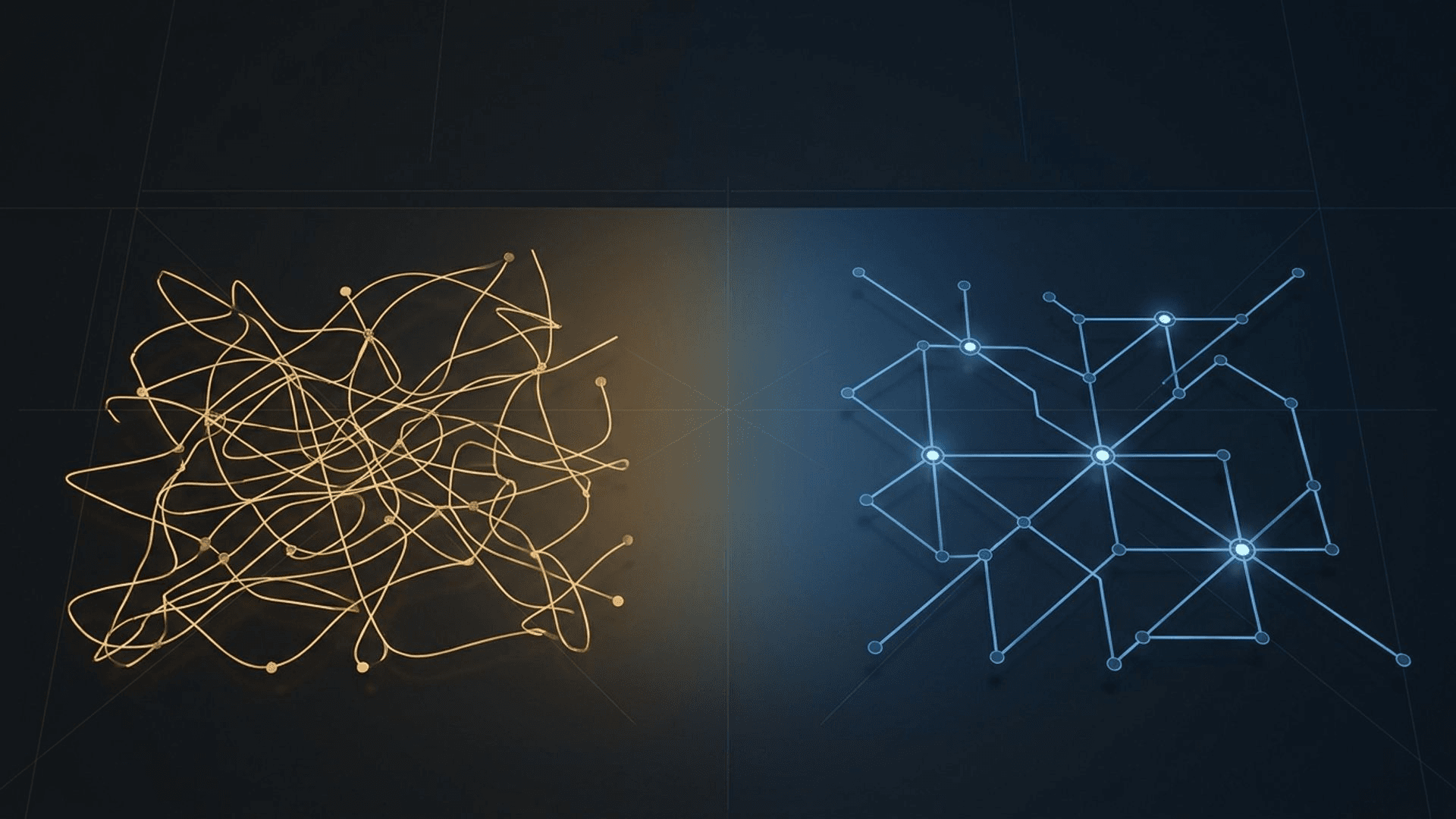
Most enterprise AI teams are building geographic maps of their agentic problems. Graph engineering is the Beck redesign: it reveals the actual topology and makes the system navigable.
The reason enterprise AI agents fail to graduate from pilot to production is not model quality, data quality, or organizational will. It is architectural. McKinsey's 2024 State of AI report noted that while interest in agentic systems is accelerating, most enterprises have "limited infrastructure for dynamic agent coordination" and rely on linear prompt chaining as the primary orchestration approach. Gartner's 2024 analysis found that the majority of organizations moving beyond experimentation defaulted to chain-of-thought pipeline architectures because they mirror familiar ETL and data engineering mental models: sequential, auditable, easy to explain to stakeholders. Pipelines are what enterprise engineering knows.
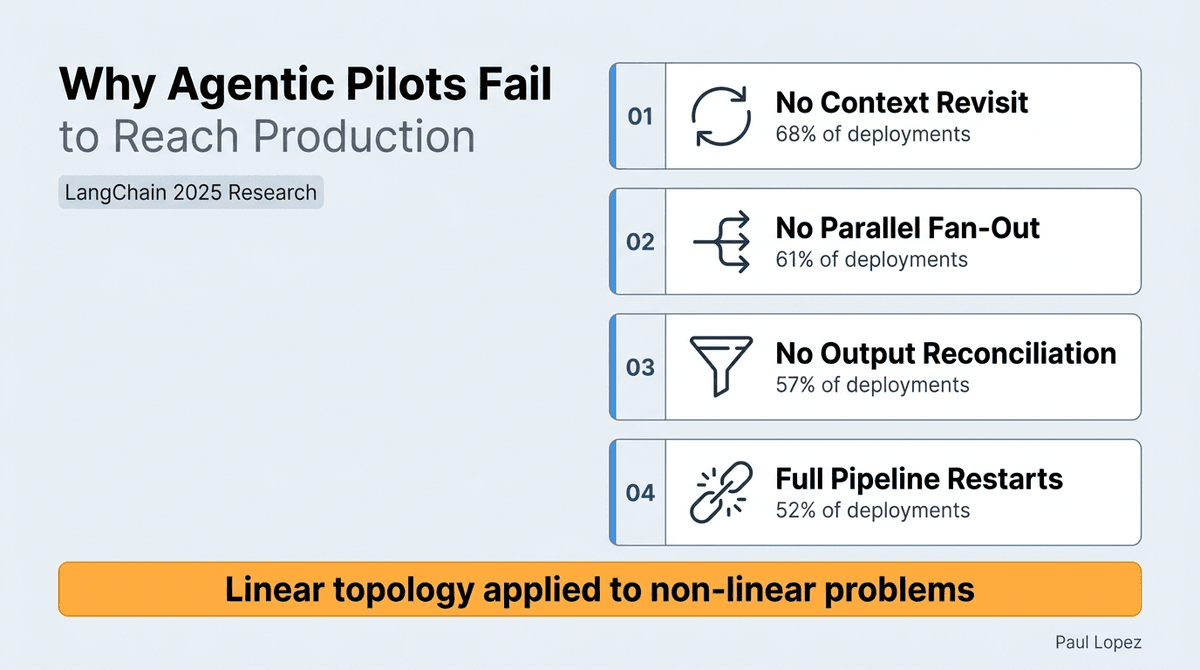
LangChain's 2025 "State of AI Agents" report analyzed production deployments across hundreds of enterprise customers and found a consistent pattern. The most common reasons agentic systems failed to graduate from pilot to production included no mechanism for a step to revisit prior context when downstream steps failed, no ability to fan out parallel workstreams, no structured way to aggregate and reconcile outputs from multiple paths, and brittle sequential dependencies that caused full-pipeline restarts on single-node failures. These are not implementation errors. They are structural consequences of applying linear topology to problems that are not linear.
The Abstraction Embedded in Every Pipeline
A linear pipeline encodes one assumption about every problem it touches: that work flows in one direction, that each stage depends on exactly the stage before it, and that no stage needs to know what any other stage decided. That assumption is correct for some problems. It is wrong for most agentic workloads at enterprise scale.
The pipeline abstraction survives in AI system design for the same reason it survived in software pipelines before it: it is the shape engineers already know. Familiarity is not the same as fitness. A pipeline is easy to reason about in isolation and hard to adapt when conditions change, because the sequence is the architecture. Change the problem, and you change the pipeline. Graphs separate the topology from the work. Change the conditions, and the graph routes differently without touching the underlying nodes.
The specific failure modes that expose this gap appear in three scenarios that production agentic systems encounter constantly. When two agents need results from each other before either can proceed, the pipeline has no representation for that mutual dependency; one of them has to go first, which means one of them is always waiting on stale information. When the right path through a workflow depends on a result you cannot know until partway through execution, the pipeline cannot route conditionally at runtime because its route is baked in at design time. When the same piece of work needs to be validated by multiple independent paths before it exits the system, the pipeline has no native convergence point; verification becomes a final step that can only pass or fail, not route back for correction. Each of these is a structural failure. The pipeline did not fail because the code was wrong. It failed because the abstraction could not represent what the problem required.
What Graph Engineering Actually Changes
Graph engineering treats an AI system as a set of entities and the relationships between them, not as a sequence of steps. That is not a philosophical distinction. It is a design decision with concrete consequences for how the system handles parallel work, conditional routing, failure, and adaptation.
The graph orchestrator does not execute a script. It plans, routes, and adapts. Each node makes local decisions within a typed state contract. The graph ensures global coherence by managing what information flows where and how results converge. Observability is structural: because the graph defines every path work can take, every execution is traceable by construction, not by instrumentation bolted on after the fact.
Three topology patterns directly address the failure modes described above, and they are the ones most enterprise architects will face decisions about first.
Fan-out runs parallel exploration before convergence. When the same problem benefits from multiple independent approaches simultaneously, the pipeline forces them into sequence and compounds latency. The fan-out topology distributes work across parallel nodes and aggregates results. Coverage improves. Latency drops. The parallelism is structural, not a workaround bolted on through async calls in a linear chain.
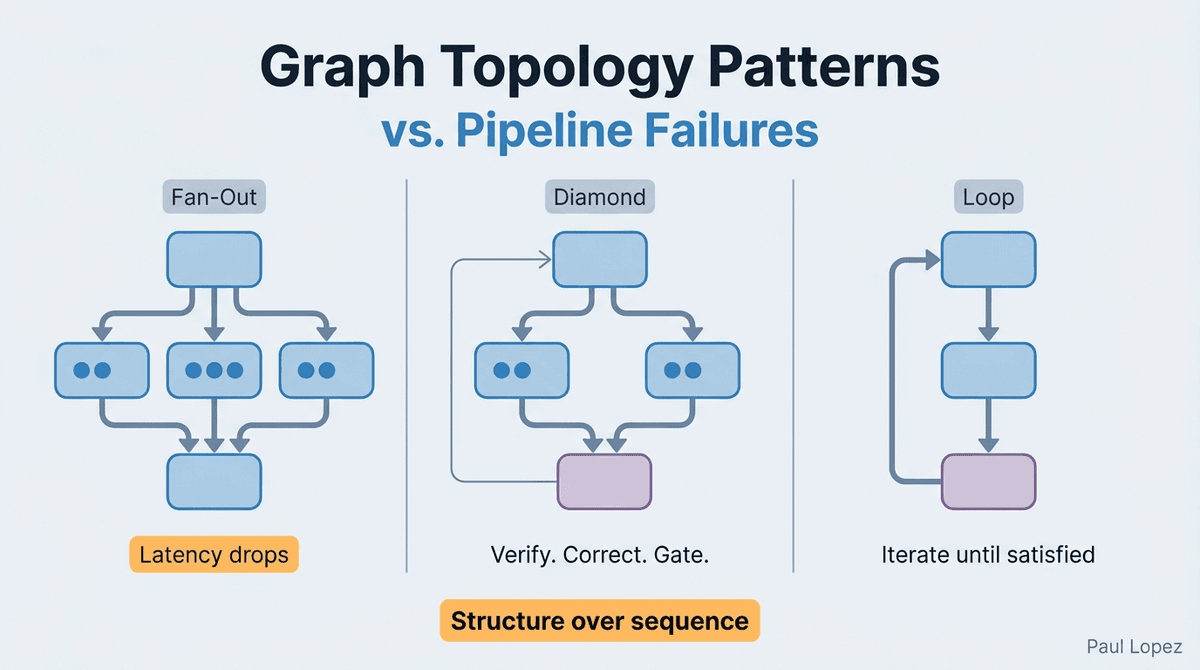
The diamond pattern extends fan-out to make verification a structural commitment, not an afterthought. Branch to explore, converge to verify. In a pipeline, there is no native verification node; a result exits the system if nothing looks obviously wrong. In a diamond topology, the verifier is a named gate. Results that fail it route back for correction, not forward for delivery. This pattern appears throughout production RAG architectures, code generation workflows, and multi-hypothesis research agents where a single-pass answer is structurally insufficient.
The loop topology handles the class of problems where the first answer is rarely the right answer. The pipeline terminates. The loop continues until an evaluation node is satisfied. Prior authorization justification is a direct example: the clinical rule check returns a result, a verifier node scores it against payer criteria, and if the score falls short the loop runs another iteration with refined evidence. Clinical coding behaves the same way. These are problems with an inherent feedback structure. The loop topology matches that structure. The pipeline cannot represent it at all.
The principle the architecture calls out is worth naming directly: fit the problem, not the model. The topology is not chosen because a framework makes it easy or because the team is familiar with it. It is chosen because it matches the actual structure of the problem. That is the discipline Beck applied to the tube map: stop asking how to represent the geography accurately and start asking what structure the passenger actually needs to navigate.
The Primitives That Make It Operational
Graph-based agentic systems run on a small set of primitives that every enterprise architect needs to understand before building one. Four of them do the most work in production.
The router is the node that decides where information and work flow based on conditions at runtime, not at design time. This is the primitive that makes conditional routing possible in practice. A pipeline encodes the route during development. A router evaluates conditions during execution and sends work to the appropriate next node based on the current state of the system. AI engineer Shreya Shankar put it precisely in a widely-cited 2024 essay: "Most production AI pipelines fail silently at the routing layer; not because the models are wrong but because there's no architecture for deciding which model or step should handle a given input at runtime." The router is that architecture.
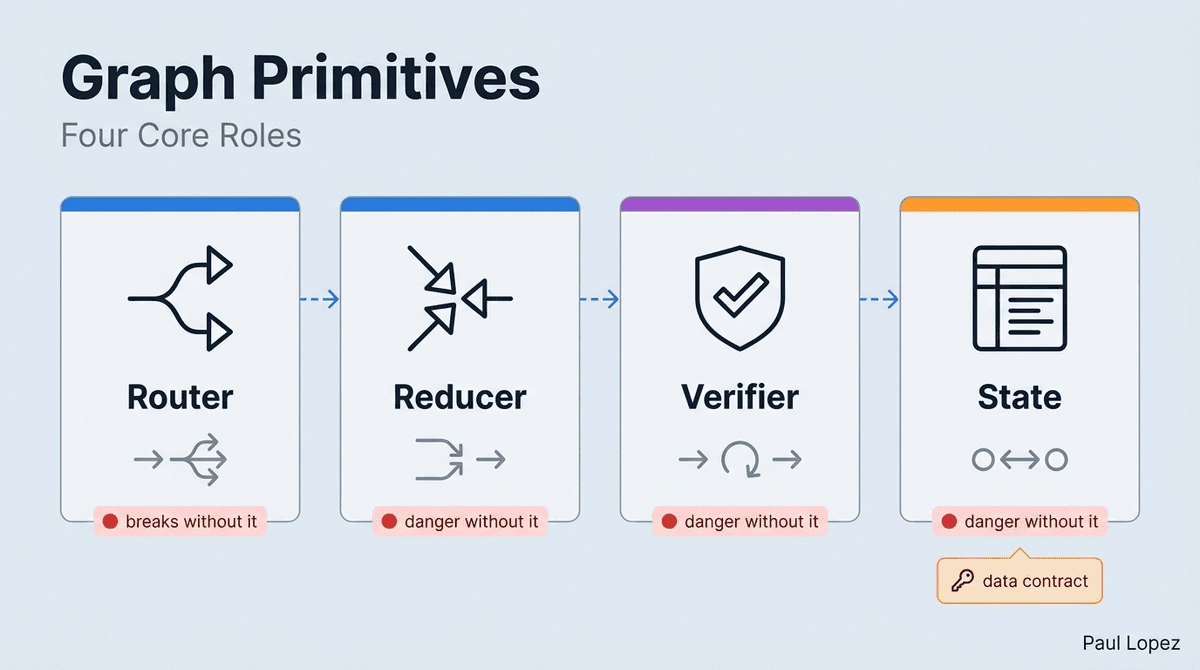
The reducer aggregates and distills results from parallel paths into a single coherent output. Without a reducer, the fan-out topology has no convergence point. Parallel agents produce independent outputs with no mechanism to reconcile them, which means the system either picks one arbitrarily or fails at the merge. The reducer resolves conflicts, synthesizes results, and produces a typed output that downstream nodes can act on. It is what makes fan-in topologies operationally sound rather than architecturally aspirational.
The verifier checks, scores, and validates before results exit the system. In a pipeline, verification is usually a final pass that ships results if nothing looks wrong. In a graph, the verifier is a named node with a defined responsibility: gate outputs, score them against criteria, and route failures back into the loop rather than forward to the user. Human-in-the-loop checkpoints are a natural extension of the verifier pattern. Design them into the topology from the start, and they function as structured gates. Bolt them onto the end of a pipeline, and they function as fire alarms: useful only after something has already gone wrong.
State is the typed data contract that defines what nodes know and what edges carry. In a pipeline, state is typically implicit: each step transforms input to output and passes the result forward, and the system has no explicit model of what information exists at any given point in execution. In a graph-based system, state is explicit and typed. Every node reads from and writes to state in defined ways. This is what makes parallel execution safe. Nodes do not share mutable global state; they read typed inputs and produce typed outputs, and the graph manages the merge through reducers and routing logic. State is also what makes observability structural rather than aspirational: if the state contract is well-defined, every execution is auditable by reading the state log.
The Honest Limitation
Graph architectures are harder to operate than linear pipelines. That is not a caveat to dismiss in a footnote. It is the central tradeoff and the intelligent reader will raise it.
A mesh topology with high connectivity and redundant paths has more failure modes to diagnose than a fan-out pipeline with clean logging. A loop topology with a feedback-driven verifier requires a termination condition that someone has to design correctly, or the system iterates indefinitely. The coordination complexity is real, and teams that reach for mesh architectures without instrumenting every node and edge are not building resilient systems. They are building expensive, opaque ones.
The answer is not that graphs are always better. The answer is that topology should be chosen deliberately, and the simplest topology that fits the problem is always correct. A linear pipeline is the right architecture for a problem that is actually linear. The error is not using pipelines. The error is using pipelines for problems that are not linear, because pipelines are familiar and graphs require a different kind of design discipline.
Graph engineering does not reduce complexity. It makes the real complexity of the problem visible and manageable, rather than hiding it inside a sequence that looks simple until it fails.
The practical instruction that follows from this is: map the problem topology before choosing the implementation topology. If the problem map is linear, build a linear graph. If the map has a verification branch, build a diamond. If the map has a parallel exploration phase followed by convergence, build a fan-out with a reducer. The discipline is the mapping exercise, not the sophistication of the resulting structure. Teams that skip the mapping exercise and select topology by default are making an architectural decision without knowing they are making one.
What This Means for Enterprise Programs
Topology selection is an architectural governance decision. Most enterprise teams treat it as an implementation detail, which means the decision gets made implicitly, usually in favor of whatever the framework makes easiest, which is almost always a linear pipeline. McKinsey's 2024 research found that the strongest predictor of production AI success was whether AI engineering teams had a formal partnership with platform and infrastructure teams, not AI model quality and not dataset size. That finding points to the same root cause: successful programs treat architecture as a program-level concern, not a team-level one.
The practical consequence shows up clearly in payer-side agentic workflows. A prior authorization system I designed required results from three parallel clinical rule checks before a routing decision could be made. A pipeline forced those checks to run serially: one completed, passed its output forward, and the next began. A fan-in topology ran them in parallel, reduced latency by roughly two-thirds, and made the convergence point explicit rather than implicit. The change was not a model improvement or a prompt engineering refinement. It was a topology correction. The problem had always been parallel; the implementation had been forcing it to be sequential because sequential was easier to explain in the initial design review. That gap between problem structure and implementation structure is where most enterprise AI programs silently accumulate failure.
The observability principle embedded in graph-based systems reinforces why this matters at program scale. Everything observable. Everything traceable. In a well-structured graph, this is not an instrumentation problem. The graph's own topology is the trace. Every execution follows a path through the graph, and that path is the audit log. Each node transition, each routing decision, each state mutation is a first-class event in the execution record. Compliance teams in regulated industries understand immediately why that matters. Operational teams understand it the first time they have to debug a failure in a pipeline that passed no structured trace of what it decided or why.
The Map That Shows You Where to Go
Beck did not make the Underground simpler. He made it legible. The same choice is available for agentic systems, and it carries the same tradeoff: the map that looks familiar is not always the map that shows you where to go.
The choice of abstraction is the most consequential design decision in an agentic system. Most enterprise teams are making it by default rather than by design. A pipeline is a choice. A graph is a choice. The difference is whether the choice was made because it fits the problem or because it was already familiar. What you now know is that the failure most often attributed to model limitations, data quality, or insufficient prompt engineering is frequently an architecture problem in disguise, and the architecture problem has a name: the wrong topology for the actual structure of the work.
References
[1] Gartner. "Enterprise AI Adoption Patterns 2024." Gartner Research, 2024.
[2] McKinsey & Company. "The State of AI in 2024." McKinsey Global Institute, 2024. https://www.mckinsey.com/capabilities/quantumblack/our-insights/the-state-of-ai
[3] LangChain. "State of AI Agents 2025." LangChain, 2025. https://www.langchain.com/stateofaiagents
[4] Shankar, Shreya. "Why AI Pipelines Fail in Production." 2024.
[5] Wooldridge, Michael, and Nicholas R. Jennings. "Intelligent Agents: Theory and Practice." The Knowledge Engineering Review, Vol. 10, No. 2, 1995.
[6] Microsoft Research. "AutoGen: Enabling Next-Gen LLM Applications via Multi-Agent Conversation." Microsoft Research, 2024. https://www.microsoft.com/en-us/research/project/autogen/
[7] LangGraph Documentation. "Graph Topology Patterns." LangChain, 2024. https://langchain-ai.github.io/langgraph/
[8] Various. Distributed systems design literature on fan-out, fan-in, and diamond patterns. 2023-2024.
[9] Edge, Darren, et al. "From Local to Global: A Graph RAG Approach to Query-Focused Summarization." Microsoft Research, 2024. https://arxiv.org/abs/2404.16130
[10] Reyes, Eno. "What Production AI Programs Have in Common." The Pragmatic Engineer, 2025.
[11] Various enterprise AI program case studies cited in McKinsey 2024 and LangChain 2025 reports.
[12] Beck, Harry. Original design notes and correspondence with London Underground, 1931-1933. London Transport Museum archive.
[13] Garland, Ken. Mr Beck's Underground Map. Capital Transport Publishing, 1994.