
Why Your AI Agent's Costs Spiral Out of Control
Ferris couldn't unwind the odometer—and you can't unspool your agent's runaway costs after the invoice lands. Here's where to look before you optimize the wrong thing.

Your Agent's Odometer Only Runs Forward
Why cost per decision belongs in the architecture review, and how to tell a cost bug from a broken cost meter before you optimize the wrong thing.
In the third act of Ferris Bueller's Day Off, Cameron and Ferris jack up the Ferrari and run it in reverse, wheels spinning, trying to peel the miles back off the odometer. The logic is understandable: the number went up, so run the mechanism backward and bring it down. What they discover is that the odometer is not a setting. It is a record. It captures what the engine already consumed, and no amount of reverse momentum changes the fuel that burned to get there. The car goes through the garage window anyway.
The meter was never the problem. The driving was.
Your agent ran last night. The invoice arrived this morning. You know the monthly number because you have seen that line before, and it is trending in one direction. What you cannot tell your CFO, your engineering lead, or yourself is what that agent spent on a single completed task, which design decision is responsible for the expensive outlier runs, or whether the number on the dashboard reflects what the provider actually billed. That gap, not the invoice total, is where projects die.
Cost Is Decided at Runtime, Which Is Why It Belongs in the Design
Most software cost is predictable because execution paths are fixed. A database query has a known plan. An API call has a known price per request. You can model these things before you ship and revisit them when traffic changes. None of that applies to an agentic system, because the agent decides at runtime what to do next.
Reasoning loops extend as long as the agent judges more reasoning is required. Tool calls fan out based on what the previous call returned. Retry policies activate based on confidence thresholds the model evaluates in flight. Each agent turn appends to a context window that the next turn must re-read in full, which means cost per turn grows with the length of the session, not with the complexity of the individual request.
An orchestrator managing sub-agents inherits this problem at scale. Every worker's context accumulates inside the orchestrator's own context, which means the coordinator's token bill is a function of every worker's conversation history, not just its own.
An agentic system decides at runtime how much of your budget to spend. That single property is what separates agent economics from every cost model your organization already knows how to manage. A traditional service has a cost per request you can calculate from its execution path, because the execution path is fixed. An agent chooses its path, chooses how many tools to call, chooses whether to reason again before answering, and every one of those choices has a price.
This is why a spend cap is a fire alarm and not a design. A cap tells you that something went wrong after enough of it went wrong to matter. It cannot tell you which decision node made the expensive choice, whether the expense was justified by the outcome, or whether the same spend produced a better answer or merely a longer one.
The design question is not "what will this cost." It is "what is the maximum this specific decision path is permitted to cost, and what happens at the boundary." Answer that at the architecture layer and the invoice becomes a confirmation rather than a discovery.
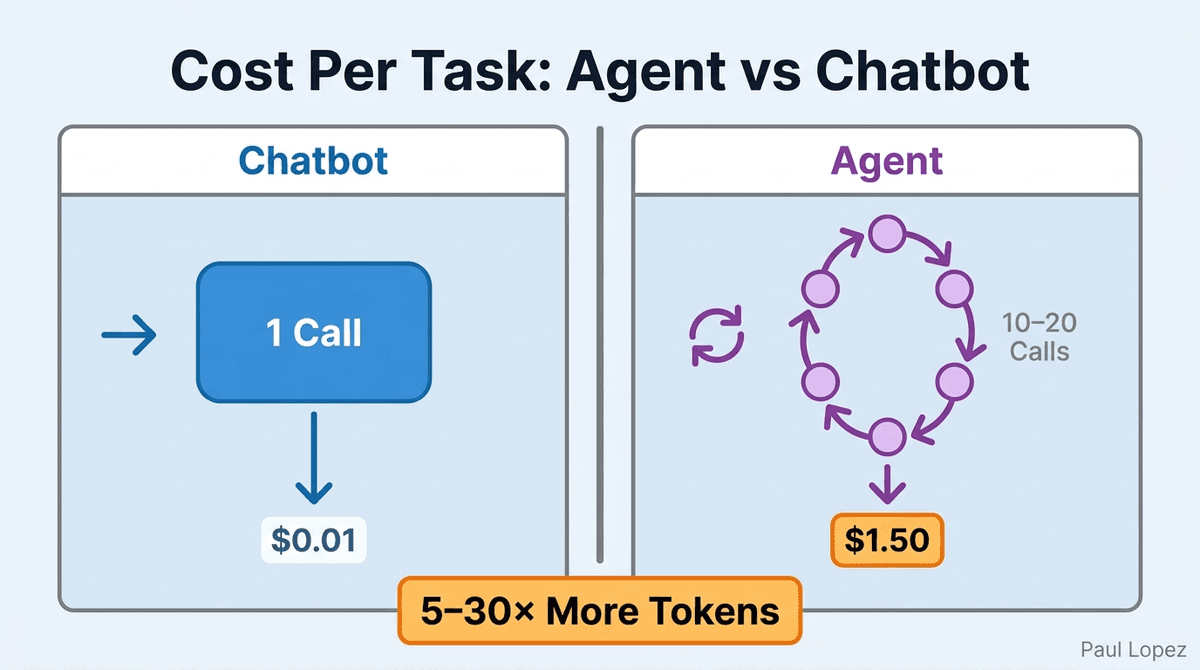
Gartner's March 2026 tokenomics analysis quantifies the gap: agentic systems consume between 5 and 30 times more tokens per task than a standard chatbot, and a task that costs a chatbot a cent can cost an agent a dollar fifty. The magnitude matters less than the structural reason. A chatbot triggers one inference call. An agentic loop triggers ten to twenty for a single user-initiated task. The relevant unit of cost is not the prompt. It is the completed task, including every model call, every retry, and every context re-read the agent decided to make along the way.
The Levers, In the Order That Actually Matters
Most cost optimization guides hand you a checklist. The checklist is not wrong, but the ordering is the part that matters, because only the first lever cannot be applied after launch.
The first lever is the number of model calls the design requires. Architectural decisions about how reasoning is structured, whether sub-agents are necessary or cosmetic, whether tool calls are sequential or parallelized, and whether the agent re-reads the full context or a compressed version on each turn all live here. Changing this after deployment is not tuning. It is redesign. Every other lever is applied to a call count this decision already fixed.
The second lever is model selection per decision node. Not per system. Not a single model for all agent work. Each node in the decision graph has a task with a difficulty level, and the cost of routing a classification step to a frontier model when a nano model completes it correctly is pure waste. A 70/20/10 distribution, where routine scanning and classification go to models priced around $0.10 per million tokens, drafting goes to mid-tier models in the $1 to $3 range, and only final decisions reach frontier models at $10 to $15, produces 60 to 80 percent average cost reduction versus a single-model architecture. The counterintuitive case also holds: for genuinely complex agent steps, a more capable model can be cheaper because it reaches the correct answer in fewer iterations.
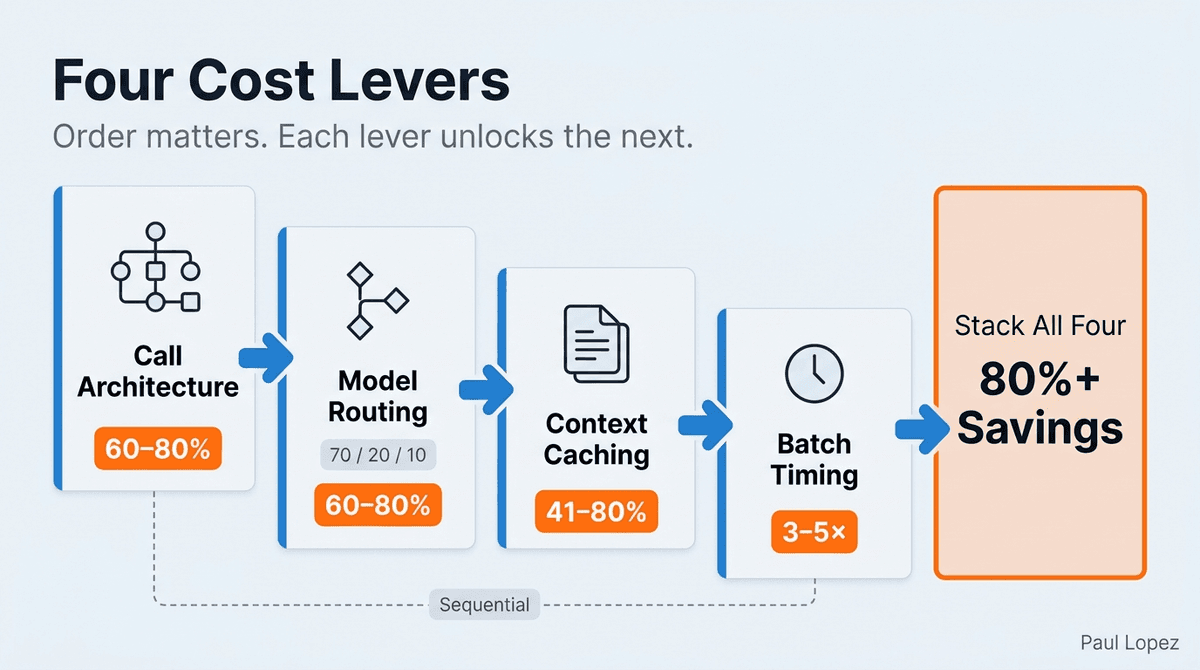
The third lever is context discipline, which has two components. Prompt caching handles the static parts: system prompts, shared instructions, stable knowledge. Peer-reviewed research published in early 2026 puts caching at 41 to 80 percent cost reduction and 13 to 31 percent latency improvement on time-to-first-token. Anthropic prices cached input tokens at roughly one-tenth of normal input cost, so the economics reward getting cache boundaries right. The dynamic parts require compaction: stripping stale conversation turns, boilerplate headers, and full-file includes the model already processed before each new inference call. JetBrains found that summarization-based compaction produces 13 to 15 percent longer agent trajectories than verbatim compaction, because agents re-derive information that was paraphrased away rather than preserved. Verbatim compaction is the safer default.
The fourth lever is invocation timing. Background and async tasks run more cheaply through batch endpoints, with throughput improvements translating to 3 to 5 times cost reduction on high-volume jobs. The rule is simple: if no user is waiting on a response in real time, it should be batched. If a user is waiting, batching breaks the experience and should not be applied.
Stacking the first three levers well, specifically architectural call count, model routing, and caching, gets most teams to 60 to 80 percent bill reduction. The fourth adds headroom for workloads that tolerate latency. None of them work if the call count from the first decision is not addressed, because you are then optimizing the cost per call against a call count nobody bounded.
A Cost Bug and a Broken Cost Meter Are Not the Same Emergency
There are two failures that produce the same symptom, and treating them as one problem is how teams spend a quarter optimizing an architecture that was never the issue. The first is a cost bug: the system is genuinely consuming more than the design intended, usually through a loop, a retry policy, or a fan-out nobody bounded. The second is a cost-measurement bug: the system is consuming what it was always consuming, and the instrument reporting it is wrong.
The distinguishing test is cheap and almost nobody runs it. Take a small set of requests with known, hand-counted consumption, run them through the production path, and compare what the meter says against what you counted. If the meter disagrees, you do not have a cost problem yet. You have a visibility problem, and every optimization you make while the meter is wrong is a guess wearing a lab coat.
Fix the instrument first. An architecture decision made on bad telemetry is not a decision, it is a coin flip with extra steps.
Agentic systems create specific ways for meters to go wrong. Cached tokens get counted at full rate, or not counted at all, depending on how the telemetry layer was wired. Retried calls get attributed to a single logical request in one tracing framework and dropped entirely in another. Tool-invoked sub-agent calls get billed to a different trace than the root request that triggered them. Streaming responses tally differently from batched ones in aggregators that were built expecting the latter. Aggregation windows smooth over exactly the spikes you needed to see, reporting a calm average where the actual distribution had outliers ten times the mean.
A cost dashboard reporting a number so calm and so flat it looks like a flat-fee service should be the first suspect, not a reassurance.
The instrumentation minimum that makes the distinguishing test possible is: a trace identifier that survives the entire decision, per-node token counts rather than per-session aggregates, retry counts recorded separately from call counts so you can see how much of the spend was recovery work, and a monthly reconciliation against what the provider actually invoiced. That last step closes the loop on every error the internal meter introduced. Treat it as a floor. Anything below it is darkness with a number attached.
What I Learned Paying for This Twice
A returns processing agent I built had a retry parameter misconfigured at the tool-call layer. A single user request produced nine billed model calls where one was intended. The important detail is not the waste. It is that every one of those nine calls succeeded. Nothing in the logs flagged an error. The system was behaving correctly and expensively at the same time, which is the hardest category of problem to catch, because the signals you rely on to detect failure are all green.
The cost dashboard reported a flat line. Time went into tuning context window parameters and adjusting model selection thresholds, because the number on the screen pointed there. None of it moved the bill. What eventually moved the bill was reconciling internal telemetry against the provider's usage report and finding that the two numbers did not agree. The retry loop was invisible to the internal meter and visible on the invoice. That experience turned cost instrumentation from a post-launch task into an architecture gate. If the meter cannot survive a reconciliation test before the system scales, the architecture is not ready to scale.
The same obligation applies to evaluation harnesses, as I wrote in the eval framework piece: the harness has the same maintenance requirement as the system it measures, and it degrades the same way the system does if nobody owns it.
The Case Against Building Any of This
The strongest version of the counterargument deserves a fair hearing. Instrumentation costs real money. Engineering time spent on tracing, attribution, and reconciliation pipelines is time not spent on the product. Model prices have fallen roughly 280 times over the past two years while enterprise AI spend has risen 320 percent. If the price curve continues, the constraint being optimized might dissolve faster than the instrumentation pays back.
The honest counterargument is that instrumentation costs real money and model prices keep falling. Every span you emit, every token you tag, every attribution record you store is engineering time and storage that could have gone to the product, and there is a defensible position that this machinery optimizes a constraint the market is already dissolving one price cut at a time.
The falling price argument is correct about unit economics and wrong about the failure mode. Cheaper tokens make an unbounded loop cheaper per unit and no less unbounded. The systems that blow up a budget do not do it because tokens are expensive. They do it because the system decided at runtime to consume a quantity nobody had bounded, and that quantity is set by the architecture, not by the rate card.
The concession is real, though, and it has a threshold. Below a certain request volume, full per-decision attribution is overkill, and a monthly reconciliation plus a hard cap is the proportionate answer. The line falls where a single anomalous day would cost more than the instrumentation does in a quarter.
Run that math with your own numbers. If an unbounded overnight run could consume a quarter's worth of instrumentation budget before anyone noticed, the instrumentation is worth it. If the entire monthly spend is small enough that even a total runaway event costs less than the engineering time to prevent it, a cap and a reconciliation are sufficient. The test is specific to your volume and your rate card. Gartner named cost overruns as one of three co-equal drivers behind its June 2025 prediction that over 40 percent of agentic AI projects will be canceled by the end of 2027, alongside unclear business value and inadequate risk controls. Forrester independently projected that 25 percent of planned AI spending would defer into 2027 as financial discipline tightens. The risk is not hypothetical for most enterprise deployments at current scale.
Worth noting: for some prediction tasks inside an agent's decision graph, the cheapest calibrated option is not a language model at all, a point explored in more detail in the XGBoost and SHAP piece. Routing a structured classification step to a gradient-boosted model eliminates the token cost entirely.
The Decision Belongs Before the First Turn
Put the cost model in the design review, next to latency and accuracy, before the architecture is final. Give it a named owner. Set a stated ceiling per decision path. Audit the cost-per-completed-task before the next scaling decision, not after the invoice surprises someone.
Gartner's 40 percent cancellation forecast is not a market condition you inherit. It is a measurement failure that compounds into a budget failure, and it is preventable at the design stage.
Cameron and Ferris could not roll the Ferrari's odometer backward. The miles were already in the engine, the tires, the fuel tank, and eventually the wall. You cannot roll back your agent's token spend either, which means the only moment the decision gets made is before the wheels turn.
References
[1] Agentic AI Inference Cost: Why Agents Burn 5-30x Tokens | Spheron Blog. https://www.spheron.network/blog/agentic-ai-inference-cost-2026/
[2] AI Token Optimization: Complete Guide to Reducing LLM Costs | NeuralTrust. https://neuraltrust.ai/blog/ai-token-optimization-guide
[3] AI inference is getting cheaper, but your agents are getting more expensive. https://www.computerworld.com/article/4210786/ai-inference-is-getting-cheaper-but-your-agents-are-getting-more-expensive.html
[4] Gartner: Agentic AI won't benefit from economies of scale | Computer Weekly. https://www.computerweekly.com/news/366648782/Gartner-Agentic-AI-wont-benefit-from-economies-of-scale
[5] The Bill Arrives: How to Manage Agentic AI Costs at Scale. https://www.cockroachlabs.com/blog/agentic-ai-costs-at-scale/
[6] Token Usage Guide 2026: How Many Tokens AI Really Uses. https://iternal.ai/token-usage-guide
[7] AI Inference Cost Crisis 2026: Why Your AI Bill Is Exploding. https://oplexa.com/ai-inference-cost-crisis-2026/
[8] Gartner Predicts 40% of Agentic AI Projects Will Be Canceled by 2027. https://www.ihlservices.com/news/analyst-corner/2026/06/gartner-predicts-40-of-agentic-ai-projects-will-be-canceled-by-2027-heres-what-the-retail-store-level-shows/
[9] Gartner Predicts Over 40% of Agentic AI Projects Will Be Canceled by End of 2027. https://www.gartner.com/en/newsroom/press-releases/2025-06-25-gartner-predicts-over-40-percent-of-agentic-ai-projects-will-be-canceled-by-end-of-2027
[10] Why 40% Of Agentic AI Projects May Be Canceled By 2027. https://www.forbes.com/sites/robertszczerba/2026/07/07/why-40-of-agentic-ai-projects-may-be-canceled-by-2027/
[11] The State Of Agentic AI In 2026: Companies Are Chasing, Few Are Catching. https://www.forrester.com/blogs/the-state-of-agentic-ai-in-2026-companies-are-chasing-few-are-catching/
[12] 40% of agentic AI projects will be cancelled by 2027. https://ecorpit.com/agentic-ai-project-cancellation-governance-cost-controls-2026/
[13] Cutting LLM Inference Costs in 2026: Where Caching, Batching, and Smart Routing Actually Pay Off | GMI Cloud. https://www.gmicloud.ai/en/blog/llm-inference-cost-optimization-caching-batching-routing
[14] AI Agent Cost Optimization: How to Cut LLM Spend by 80% with Routing | Requesty. https://www.requesty.ai/blog/ai-agent-cost-optimization-how-to-cut-llm-spend-by-80-percent-with-routing
[15] LLM Cost Reduction: 12 Strategies to Cut AI Inference Costs | NeuralTrust. https://neuraltrust.ai/blog/llm-cost-reduction-guide
[16] How to Cut LLM Token Costs in 2026: Routing, Caching, Compression, and the Right Model. https://wavect.io/blog/reduce-llm-token-costs-2026/
[17] Don't Break the Cache: An Evaluation of Prompt Caching for Long-Horizon Agentic Tasks. https://arxiv.org/pdf/2601.06007
[18] Agentic Plan Caching: Test-Time Memory for Fast and Cost-Efficient LLM Agents. https://arxiv.org/pdf/2506.14852
[19] Agent Token Cost Optimization in 2026: Cut AI Inference Spend by 60-80% | AgentMarketCap. https://agentmarketcap.ai/blog/2026/04/08/agent-token-cost-optimization-production-inference-spend
[20] Why Agentic AI Projects Get Canceled (and How to Ship). https://www.digitalapplied.com/blog/agentic-ai-project-cancellations-gartner-40-percent-2026