
Why Enterprise AI Repeats Technology's Most Expensive Pattern
History's priciest tech pattern: open standards spread fast, then proprietary layers capture all the value—and AI companies are already three moves ahead.

The Open Standard Always Loses the War
Why enterprise AI is repeating the most expensive pattern in technology history, and what to do before the proprietary layer closes.
Spotify won the streaming wars, but artists spent decades fighting for something more important: catalog ownership. They largely succeeded. Your songs can move between platforms. The recorded music itself is portable. But the algorithmic playlisting logic, the listener relationship data, the editorial placement history, the "listeners also like" graph: none of that moves with you. The music is yours. The relationship between your music and your audience belongs to the platform.
Artists discovered this architecture years after the dependency formed. They optimized for catalog portability while the platforms optimized for relationship capture. By the time the music industry understood what Spotify was actually building, the behavioral context was already locked behind proprietary walls.
Enterprise AI is running the same play. And most companies are three years behind where the music industry was when they figured it out.
The Pattern Has a Name
Every major technology platform transition produces the same architecture. An open standard gets published. It is celebrated for enabling interoperability. It spreads fast because it lowers barriers. Developers build on it. Enterprises adopt it. And then, quietly, the companies with the most resources build a proprietary layer on top of the standard: one that does not violate the standard's terms, but captures all the value the standard enabled.
TCP/IP created the open internet. The platforms that monetized on top of it, Google, Amazon, Meta, became the most valuable companies in history. SMTP is the open standard for email. Gmail's machine learning models that read, categorize, and prioritize your inbox are not. HTTPS is the open standard for secure web communication. The trust signals, the certificate authority relationships, the search ranking benefits that come from a well-established HTTPS implementation: those belong to each platform that built on top of it.
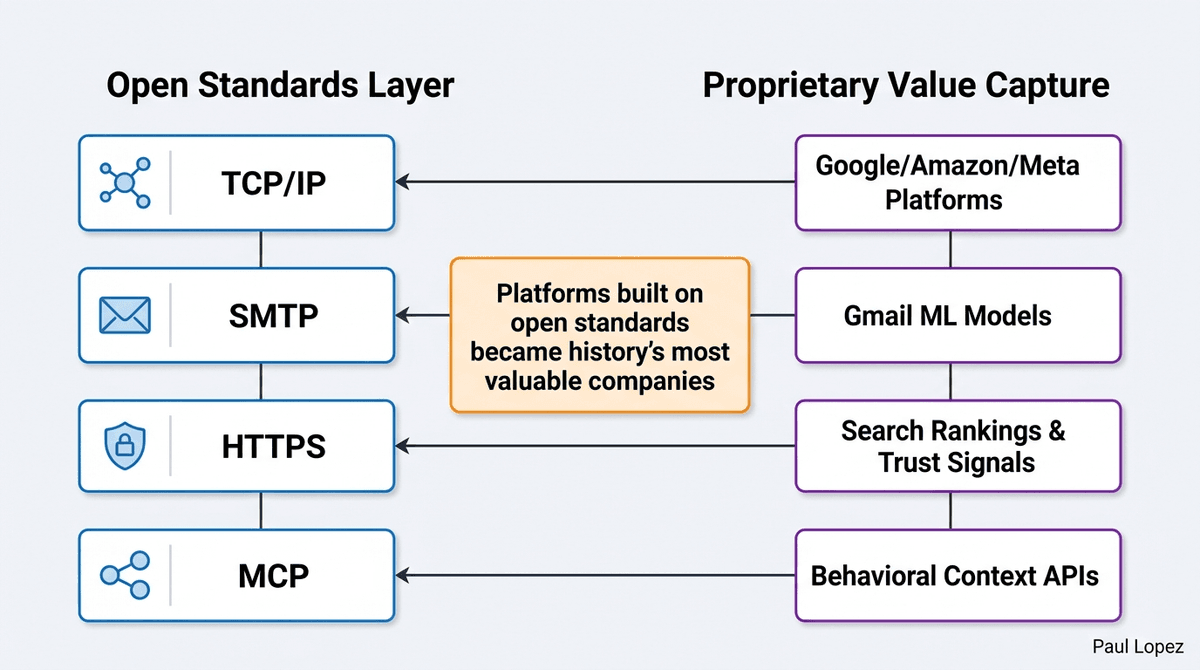
This is not a conspiracy. It is a business model. The open standard drives adoption. The proprietary layer captures margin. And the moment you build enough operational dependency on the proprietary layer, the standard's portability becomes theoretical rather than practical.
The Model Context Protocol (MCP) is the specification that tells AI agents how to call tools, access resources, and execute tasks. Published by Anthropic in late 2024 and adopted quickly by every major AI platform, it functions as the common language agents use to interact with the world. The enterprise AI agent market is projected to grow from $4.2 billion in 2024 to $28.5 billion by 2030, with 73% of enterprises planning agent implementation by 2026.
What the Proprietary Layer Looks Like Now
The major AI platforms are not hiding what they are building. They are describing it plainly in earnings calls, developer documentation, and product announcements. The language they use is instructive: persistent context, behavioral calibration, organizational learning, embedded workflows. These are not descriptions of open MCP tooling. They are descriptions of the proprietary layer being built on top of it.
The pattern is consistent across every major vendor. Publish support for the open standard. Celebrate interoperability. Then build an extension ecosystem, an agent directory, a workspace integration, a persistent context store, that operates exclusively within the vendor's environment. The skills can theoretically run anywhere MCP is supported. The behavioral context those skills accumulate while running in the vendor's persistent agent layer cannot leave.
Microsoft's Copilot Studio exemplifies this approach with "custom agent creation with organizational knowledge integration." The marketing language emphasizes how agents "learn your organization's unique patterns and preferences over time." That learning happens inside Microsoft's ecosystem. The MCP-compliant skills are portable. The accumulated organizational intelligence is not.
Why This Matters More Than the Platform Decision
If you have read this series from the beginning, you recognized that dynamic immediately. It is exactly what the first two articles described: the switching cost that grows in the dark. The agentic cognition your persistent agents accumulate inside the proprietary layer is not a side effect of your platform choice. It is the intended outcome. The vendor's commercial model depends on that accumulation. And your negotiating leverage at renewal time depends on whether you understood that before you signed.
This is not an argument against using AI platforms. They are extraordinary tools and the proprietary layers they are building will produce genuine value. This is an argument for understanding the architecture you are entering before the organizational dependency makes the architecture irrelevant to your decision.
The CFO who asked "what did we pay to build that intelligence, and what would it cost to rebuild it elsewhere" was asking the right question about the wrong layer. The proprietary behavioral context layer was designed for accumulation, not portability.
What the Pattern Implies for Enterprise Decisions
Platform selection criteria need a new column. Current evaluation frameworks score capability, integration breadth, security, and cost. They do not score portability terms for accumulated behavioral context. Teams compare response quality and API pricing while ignoring the most expensive dependency being created: the organizational intelligence that agents accumulate while operating inside each vendor's persistent context layer. That column needs to exist before the selection decision, not at renewal.
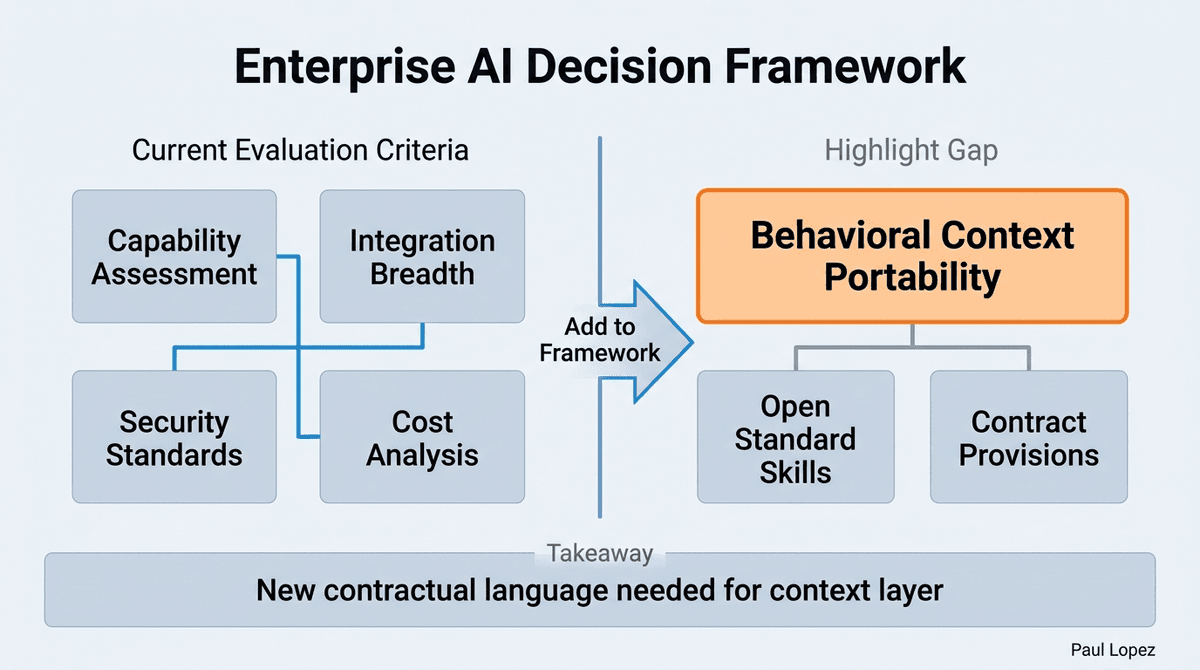
Vendor contracts need new language. The open standard gives portability of the skill definition. You need contractual provisions addressing the behavioral context layer separately. What is the vendor's obligation to export accumulated agent context on termination? What is their obligation to document what agents have learned about your organization's patterns, preferences, and workflows? The contract adequate for a stateless AI tool is not adequate for a persistent context-accumulating agent that builds institutional knowledge over months of operation.
The canonical-first architecture is the hedge. Organizations that author institutional knowledge in vendor-neutral formats first and package for specific platforms second preserve optionality that organizations building directly into proprietary layers do not. This requires a discipline of abstraction most teams skip because the proprietary tooling is faster to start with. But the speed advantage in month one becomes the switching cost in year two.
Economic leverage shifts as behavioral context accumulates. The platform that knows how your legal team prefers contract redlines formatted, how your engineering team structures code reviews, how your sales team qualifies prospects: that platform has captured intelligence that took months to develop and would take months to rebuild. The MCP standard ensures your skills can run elsewhere. It does not ensure your organizational intelligence can migrate with them.
The Window Is Closing
The music industry took a decade to understand what Spotify was building. By the time artists understood the streaming model's economics, the behavioral relationship between their music and their listeners was already owned by the platforms. The music remained theirs. The leverage did not.
Enterprise AI is three years into the equivalent moment. The open standard created the impression of portability. The proprietary layers are capturing the value. The organizations that recognize the pattern now have a window to design around it. That window has a closing date.
The next article in this series names what actually lives inside the proprietary layer: the five categories of organizational intelligence your agents are accumulating, and what it would cost to rebuild each one from scratch. If you have been managing AI platforms without an inventory of those categories, that article is the starting point.