
CFOs Are Tracking the Wrong AI Metric
While CFOs count AI budget dollars, the real number climbing invisibly is what it'll cost to escape when renewal time comes.

The Hidden Cost of AI Platform Lock-In
Your CFO Is Tracking the Wrong Number
There is a scene in The Insider where the tobacco executives argue passionately about market share and quarterly earnings, using every traditional metric they have relied on for decades. They are not disputing the importance of those numbers. But they are missing the one metric that will determine their long-term survival: the litigation liability that does not appear on any balance sheet.
Enterprise AI is having its tobacco moment. And the number most CFOs are not tracking is the one that will determine how much leverage they have in the next platform renewal conversation.
Your AI platform budget has a line item. It is reviewed annually. Someone approved it. That number is visible, managed, and debated in the right rooms.
The switching cost does not have a line item. It is not reviewed. Nobody approved it. And right now, for most enterprises, it is growing faster than the budget it sits next to.
Three Costs Inside One Decision
When enterprise leaders think about AI platform switching costs, they typically think about one dimension: the migration cost. The data migration work, the integration rebuilds, the retraining and reconfiguration effort. That cost is real, measurable, and estimable. It is also the smallest of the three.
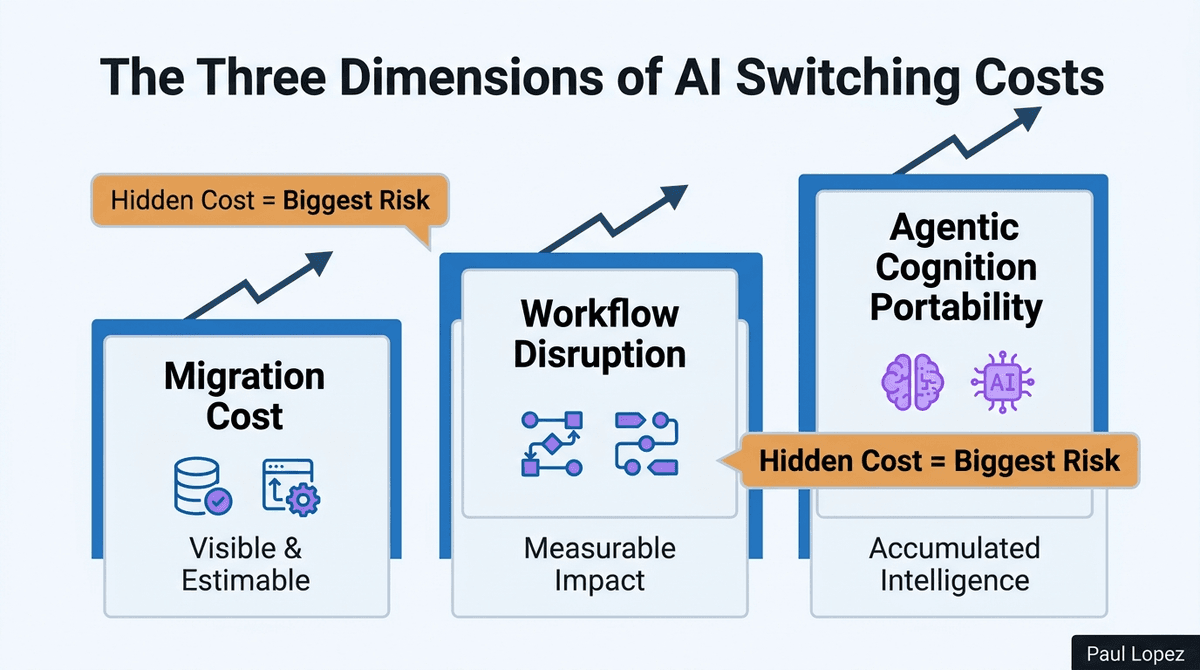
The second dimension is workflow disruption. When a persistent AI agent is embedded in operational processes, removing it is not like unplugging a piece of software. The workflows were designed around its behavior. The people using it adjusted their own processes to match how it operates. The operational dependency runs deeper than the technology stack, and the disruption cost of unwinding it rarely appears in any migration estimate.
The third dimension is the one nobody has a name for yet. I call it agentic cognition portability: the question of whether the organizational intelligence your agent has accumulated over months or years of operation can move with you if you leave the platform.
It cannot. Not today. Not on any major platform.
This is not an oversight. It is a business model.
What the Vendors Are Saying Without Saying It
Spend time reading AI platform earnings calls from the last eight quarters and a pattern emerges. The language has shifted. The framing has changed in ways that are easy to miss if you are not listening for it.
In 2023, vendors talked about features, capabilities, and integration breadth. In 2024, the language shifted toward platform depth, embedded workflows, and customer expansion within the platform ecosystem. By 2025, the dominant framing had become organizational learning, persistent context, and behavioral calibration.
That is not marketing language. That is lock-in language, wrapped in the vocabulary of value creation. And the distinction matters enormously, because lock-in purchased at market rates is a legitimate business outcome. Lock-in purchased without the buyer understanding what they are buying is a governance failure.
Your agents are not just running workflows. They are accumulating agentic cognition: the patterns, the calibration, the institutional knowledge built up through persistent operation inside your specific environment. Every quarter they run, the cost of leaving goes up. The vendor knows this. The earnings call knows this. Your CFO may not.
Why the Budget Grows Slower Than the Dependency
Enterprise AI spending is growing fast. Estimates range from 30% to 45% compound annual growth depending on the source and the definition of "AI spending." That growth is visible, tracked, and debated.
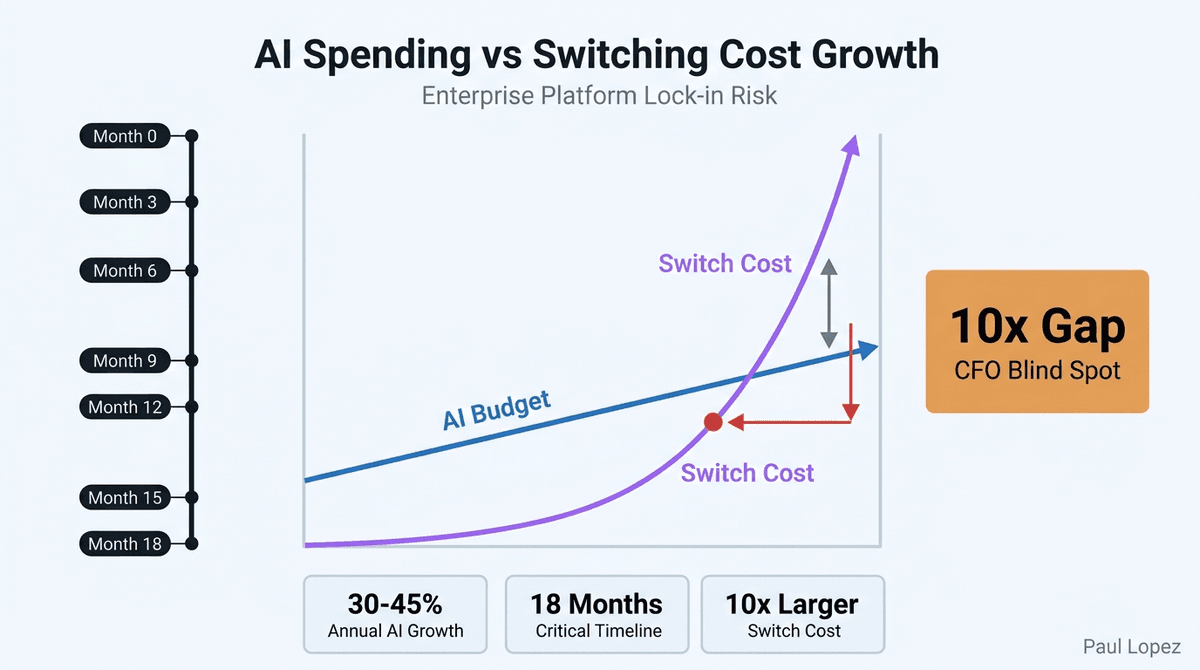
Platform switching cost, measured through the lens of agentic cognition portability, is growing differently. It does not grow at a constant rate. It compounds. The first six months of agent operation build a foundation. The next six months build on that foundation. The patterns deepen. The exceptions get handled more accurately. The institutional knowledge becomes more specific and harder to replicate.
By the time an enterprise is eighteen months into a persistent agent deployment, the switching cost is not 30% larger than it was on day one. It is an order of magnitude larger, because the accumulated cognition represents a body of operational intelligence that took the full eighteen months to develop and would take an equivalent period to redevelop on a new platform, assuming a new platform could even replicate it.
That gap, between a budget growing at 30% annually and a switching cost growing exponentially with each month of operation, is the number your CFO is not tracking.
What Maturity Looks Like
Enterprises that handle this well are starting to treat agentic cognition as an asset to be governed, not just an operational output to be consumed. That means three things in practice.
First, they inventory it. They maintain a documented map of what each persistent agent has learned, what patterns it has developed, and what operational contexts it has been calibrated against. This inventory does not prevent lock-in, but it makes the lock-in legible.
Second, they price it. During platform renewal negotiations, they bring an estimate of the switching cost that includes the cognition portability dimension, not just the data migration and integration rebuild costs. The estimate does not have to be precise to be useful. It has to be present.
Third, they negotiate for it. Some enterprises are beginning to include provisions in platform contracts that address the ownership of accumulated behavioral context and the conditions under which it can be exported or migrated. These provisions are hard to enforce today, because the technical mechanisms for exporting agentic cognition do not yet exist on most platforms. But establishing the contractual right creates leverage that does not exist if the question is never asked.
Most enterprises have not done any of these three things. They are in the same position as the tobacco executives: measuring what is easy to see, not what determines the outcome.
Three Questions Before Your Next Renewal
If you have a platform renewal coming in the next twelve months, three questions are worth answering before you walk into that conversation.
First: What is the total switching cost of leaving your current platform, including not just migration and integration but the full cost of rebuilding the agentic cognition your agents have developed? If your estimate does not include the third dimension, your number is too low.
Second: What is the rate at which your switching cost is growing relative to the value you are receiving? A switching cost that grows faster than the value delivered is a governance problem. A switching cost that grows proportionally with value is a reasonable business outcome.
Third: What provisions in your current contract address the ownership and portability of accumulated agent intelligence? If the answer is "none," that is your starting point for the next negotiation, not a reason to delay the conversation.
The CFO who tracks only the budget line is managing half the equation. The other half is growing on a different schedule, measured in months of accumulated agent operation, and it will show up eventually. It always shows up. Usually at renewal time, when the leverage is on the other side of the table.
The right number to know before you walk into that room is not just what you are spending. It is what it would cost to leave.