
Agents Are Killing Apps, but Your Data Still Wins
DoorDash now takes your order without its app. Not a surrender: in the agent era, the screen is disposable, but whoever remembers "the usual" wins.

The App Is Already Gone. The Data Never Left.
DoorDash now lets you order dinner without opening DoorDash. That sounds like a company eating its own lunch. It's the opposite.
On Sept. 30, DoorDash unveiled a text-to-order agent with a US beta waitlist. You text it through Apple Messages, it matches your phone number to your DoorDash profile, and it pulls your order history and stored payment method. "Order my usual" becomes a complete transaction. DoorDash also has an MCP server in private beta. MCP is a standard way for AI agents to connect to outside data and tools, and this one lets an agent search, build a cart and place an order on the same systems that power the DoorDash app. It targets corporate ordering: team lunches, office restocking, the stuff that eats an admin's Tuesday.
Either way, DoorDash gets paid. Co-founder Andy Fang put it plainly: "Every other AI agent is meeting you for the first time. We've known you for years."
That one line settles most of the "SaaS is dead" debate. Agents aren't killing software. They're killing the habit of opening it. The interface may be, as the Eagles sang, already gone. The source of truth stays, and it becomes more valuable.
Agents Unbundle the Interface, Not the Business
Most SaaS products quietly bundle four jobs. They help you find information, arrange it, act on it and store it. For years, vendors charged for the whole package because users had no easy way to separate the pieces.
Agents separate them. When an agent gets good at any one of those four jobs, the entire vendor relationship goes under review. Single-purpose apps get opened less often. Anything you open less often becomes easier to cancel at renewal.
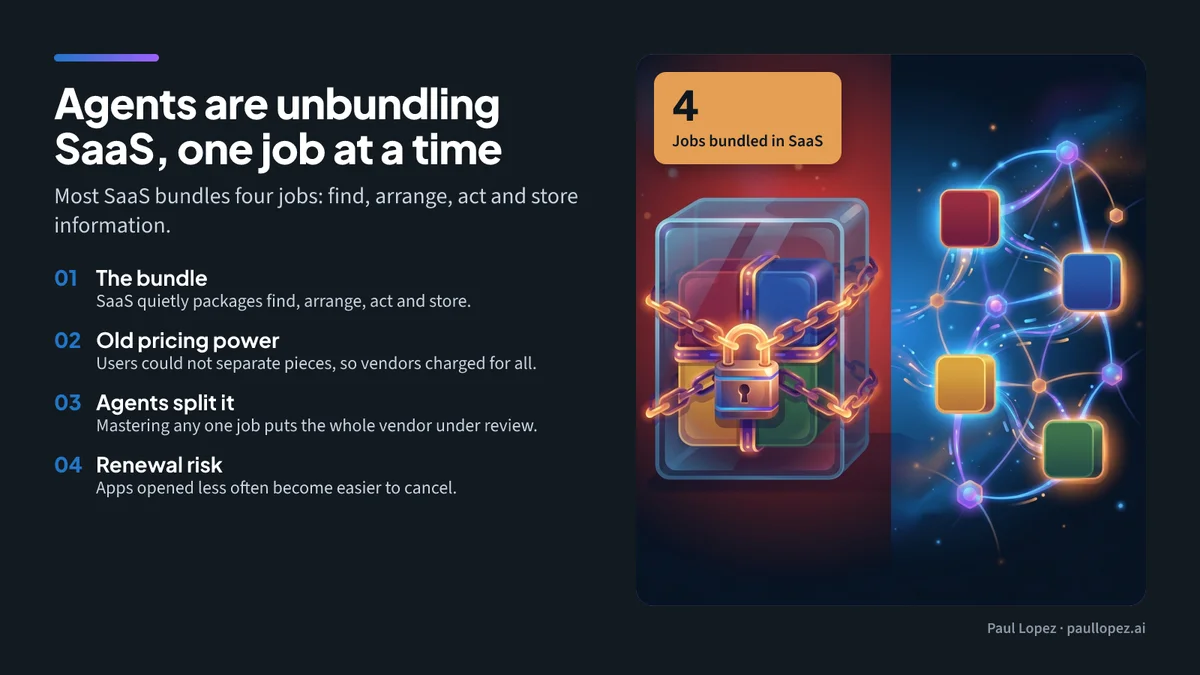
Losing the moment in the interface does not mean losing the customer transaction.
That is the DoorDash lesson, and it cuts both ways. Vendors who confuse "we own the screen" with "we own the customer" are in trouble. Vendors who own the data and the execution behind the screen are in a strong position.
There is a trap here, too. Shipping an MCP server will get you considered. It won't give anyone a reason to keep paying you. Making your product reachable by agents is table stakes, not a moat. If two providers offer equally good data and equally dependable execution, agent access makes them easier to compare and easier to swap. Comparison shopping used to take a procurement team three demos and a mediocre catered lunch. Now it happens inside a prompt.
Three Layers Decide Who Gets Paid
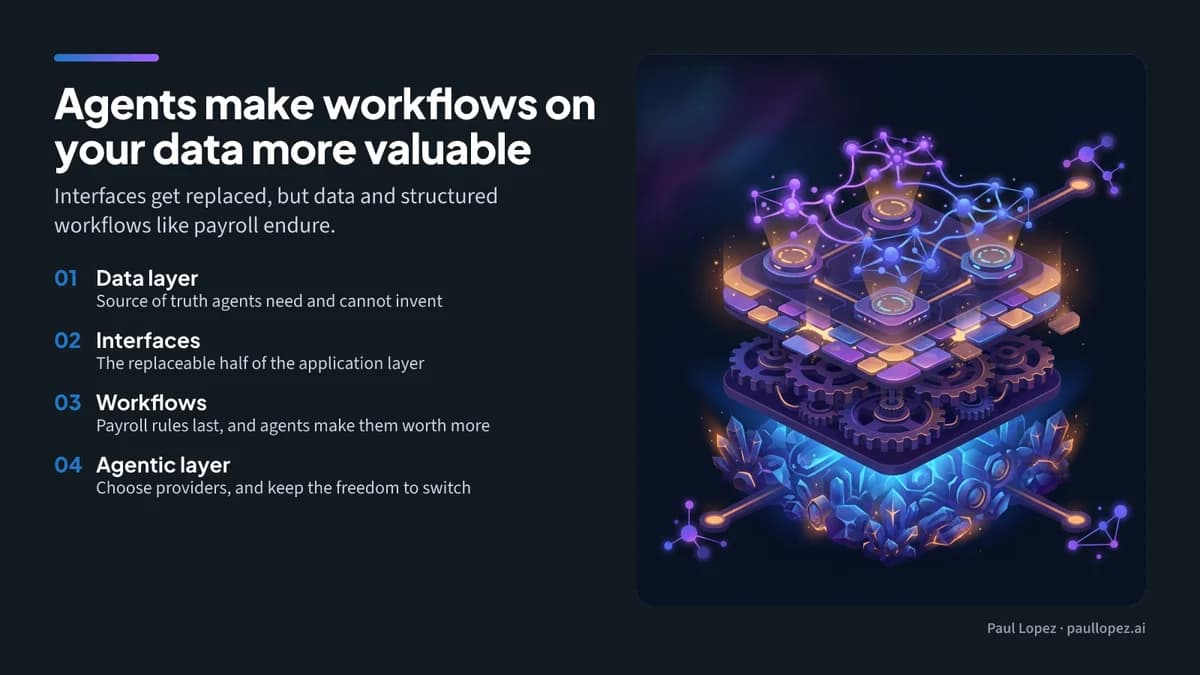
The clearest way to think about this shift is to split the stack into three layers.
The data layer is the source of truth. Customer records, transaction history, configured business rules. Agents need this data badly, and they can't make it up.
The application layer splits in two. Interfaces can be replaced. Structured workflows that run on top of data last much longer. Payroll is the textbook case. Nobody wants to hand-code payroll compliance, not even payroll people. An agent working on top of a company's configured payroll rules makes the system of record more valuable, because the complexity sits in the workflow and not in the buttons.
The agentic layer covers who provides the agents and whether your setup lets you switch providers later.
Meta's move with Muse shows how fast these layers can rearrange. Within weeks, Muse went from a personal agent to Muse for Small Business by adding data connectors. It now plugs into Instagram, Facebook and Meta ad accounts, plus Shopify, Stripe, QuickBooks, Asana, Box and Canva. TechCrunch described Meta's bet as an agent with context on the whole business beating a stand-alone chatbot. Meta also built in guardrails. Muse won't publish, send messages or buy anything without the user's approval.
The more work an agent does, the more it depends on whoever owns the truth underneath it.
The AI labs sit at the opposite end of this picture. OpenAI and Anthropic don't hold your data or own your distribution, so their pitch comes down to "bet on us for intelligence." That's why partnerships between labs and data-rich platforms matter. Buyers want to keep their options open, and vendors who make that easy will win more deals.
Healthcare shows the pattern clearly. The EHR is the data layer, and prior authorization, claims coding and HIPAA-compliant documentation are the structured workflows nobody wants to rebuild from scratch. Point tools that just sit on a clinician's screen face the most pressure. Systems that hold the clinical record and enforce compliance rules become the rails every clinical agent has to run on.
The New Lock-In Lives Inside Your Agent
Here's the risk most leadership teams haven't noticed yet.
Picture a recruiter who hasn't opened her recruiting tool in months. The vendor still gets paid. Over time, her custom agent has learned her screening criteria, each hiring manager's preferences and which candidates actually got hired. None of that sits in a dashboard. It sits in her agent setup, and only she understands it.
Then the company decides to switch AI vendors to cut costs. On a spreadsheet, the switch looks simple. In practice, it would erase weeks of accumulated progress that nobody in leadership knew existed.
Companies aren't locked into their apps anymore; they're locked into agents they can't see.
It's a Severance problem. The innie knows everything about the work, and the outie making the decisions has no access to that knowledge. When the CFO starts reviewing token costs, the most valuable AI workflows in the building are often the least visible ones. That makes them the easiest to cut by accident.
Every team uses AI differently, almost like a fingerprint. Laying one enterprise AI tool over the whole organization and calling it a strategy ignores that. It also puts at risk the institutional knowledge your best people have been building, mostly without telling anyone.
Conclusion
SaaS is being reinvented, not replaced. Value is moving toward whoever owns the source of truth and the compliance-heavy workflows built on top of it. It's moving away from whoever owns the prettiest screen. Everyone now makes software decisions, whether their title says so or not.
Here's what that means for each role:
Individuals: Don't treat your AI workflow as a private productivity hack. Walk your manager through it. If nobody else understands it, it won't survive the next budget review.
Buyers: Map how each team actually uses AI before you consolidate vendors. Then decide whether your engineers should build back-office tools that are now cheap to build, or spend that time on the work that sets you apart from competitors.
Sellers: You're selling outcomes, not seats. Make your workflows easy for AI to plug into, make your data readable by any agent or interface, and support multiple agents working together. Buyers are watching for lock-in, and they'll reward vendors who don't force it.
This week, take one hour and map your own stack. List who owns your data layer, which application workflows you couldn't live without, and where your agentic layer quietly holds knowledge that leadership has never seen. The companies that can answer those three questions will make better decisions at renewal time, and the ones that can't will pay to find out.