
Smart Prompt Caching Cuts AI Costs in Half
Early adopters are slashing AI bills 40-60% with one trick: treating prompts like database queries instead of special snowflakes.
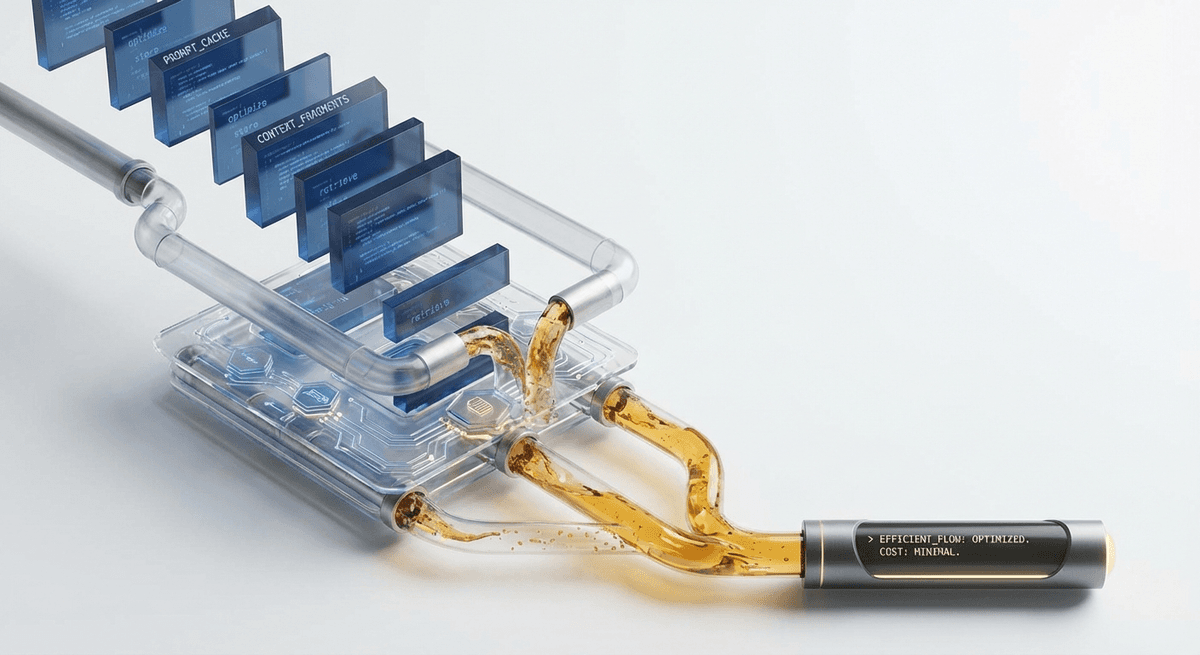
Cache Rules Everything Around Me: How Smart Prompt Caching Cut One Developer's AI Bill in Half
Last month, a healthcare AI startup watched their OpenAI bill drop from $2,400 to $1,200. No model changes. No feature cuts. Just one technique: strategic prompt caching.
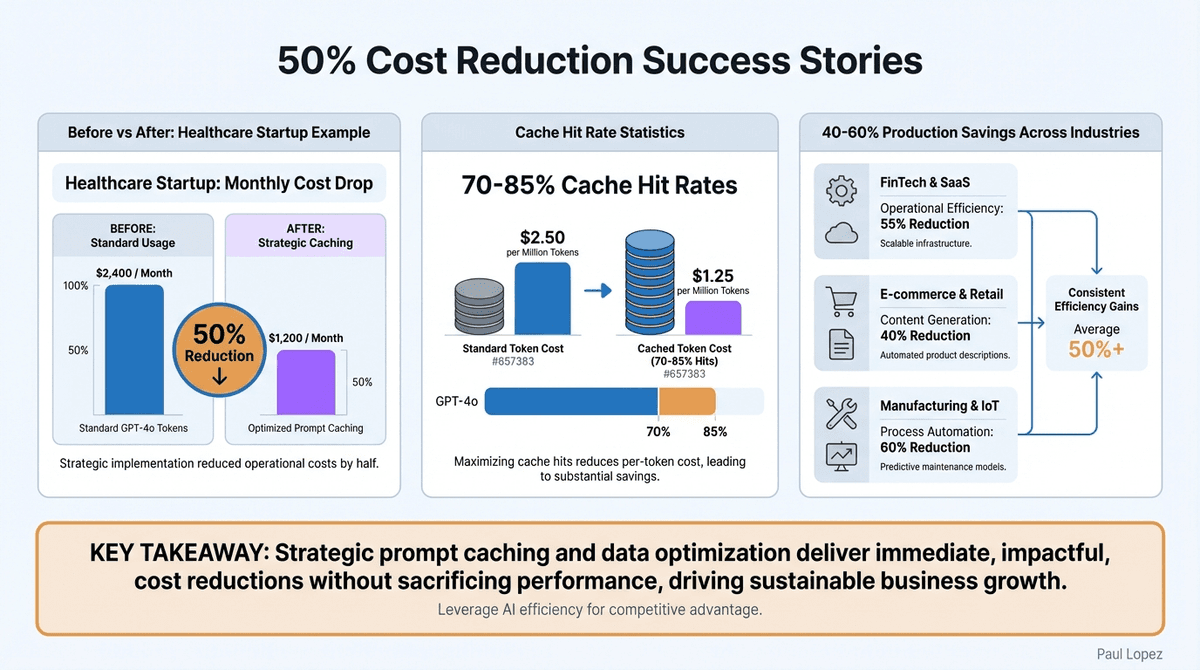
While everyone's been obsessing over which model has the biggest context window, the smart money has quietly moved to optimizing what they already have. OpenAI's prompt caching feature isn't just another API update; it's a fundamental shift in how we think about AI application economics. The early adopters are already seeing 40-60% cost reductions in production, and the gap between optimized and unoptimized applications is only going to widen.
Here's what happens when you stop treating every prompt like a special snowflake and start building systems that actually scale.
The Economics Are Simple, The Implementation Isn't
Prompt caching works by storing frequently used prompt components, letting you reuse them across multiple requests without paying full price each time. Cached tokens cost $1.25 per million instead of the standard $2.50 for GPT-4o. The math is straightforward: if half your prompt stays consistent across requests, you've just cut your input token costs in half.
The constraints matter more than the savings rate. Cached prefixes need at least 1,024 tokens to qualify, and they automatically expire after 5-10 minutes of inactivity. This isn't a set-it-and-forget-it optimization. It requires rethinking how you structure prompts from the ground up.
Think of it like database query optimization. You wouldn't run the same complex join every time you need basic user data, but that's exactly what most developers do with AI prompts. They send the same system instructions, documentation, and examples with every single request, paying full freight for content that never changes.
The successful implementations follow a clear pattern: static content up front, dynamic content at the end. Your system message, few-shot examples, and reference documentation become the cached foundation. User queries and session-specific context get appended fresh each time.
Where Caching Creates the Biggest Impact
Conversational AI applications see the most dramatic improvements. A customer service bot with a 3,000-token system prompt defining personality, policies, and response templates can cache that entire foundation. Every conversation starts with the same context, but each exchange adds new dynamic content. The result: consistent bot behavior with dramatically lower costs per interaction.
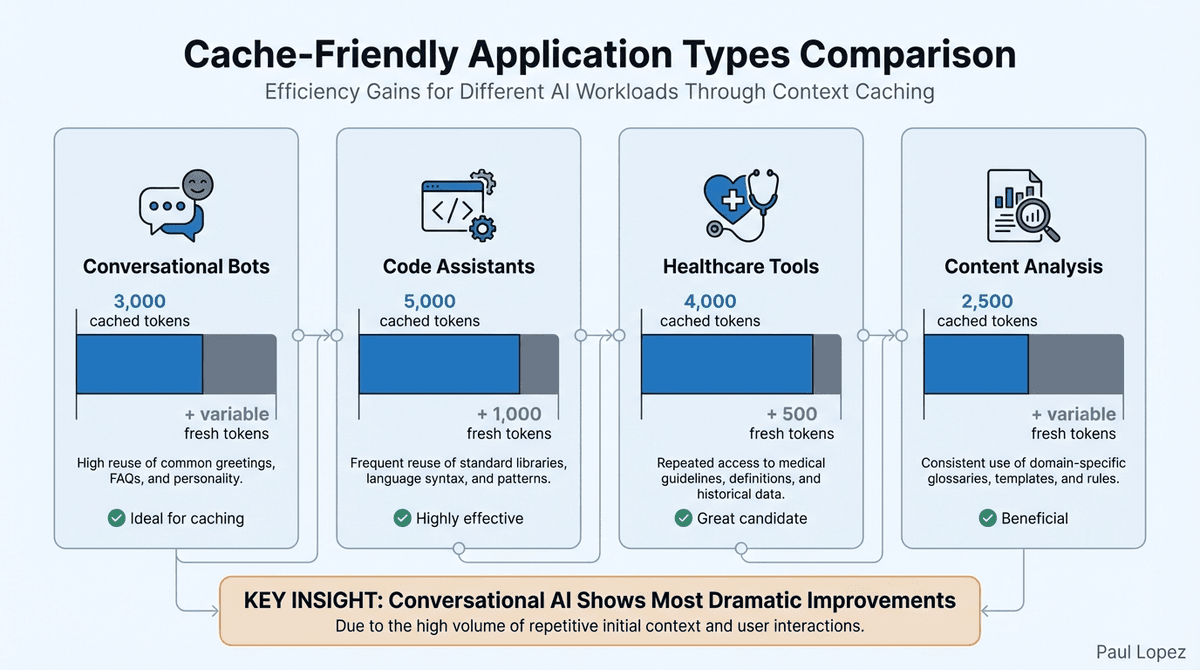
Code assistants represent another sweet spot. GitHub Copilot-style applications typically load extensive documentation, API references, and coding standards with each request. A typical implementation might include 5,000 tokens of Python documentation and coding standards, then append 1,000 tokens of specific user code. Cache the documentation, pay fresh rates only for the user's actual problem.
Healthcare applications particularly benefit from this approach. Medical AI tools often require extensive context about clinical guidelines, drug interactions, and diagnostic criteria. A symptom analysis tool might load 4,000 tokens of medical reference material, then process 500 tokens of patient symptoms. The reference material stays cached, the patient data refreshes each time.
Content analysis workflows show similar patterns. Document summarization tools, sentiment analysis systems, and content moderation platforms typically use consistent instruction sets with variable input. Cache the instructions and examples, process the unique content fresh.
The pattern across all successful implementations: high-volume applications with consistent context requirements and variable user inputs.
Architectural Decisions That Make or Break Performance
The biggest mistake developers make is trying to optimize existing prompts instead of designing cache-friendly architectures from scratch. Like trying to retrofit a house for solar panels, it's technically possible but rarely optimal.
Successful caching strategies start with prompt archaeology. Map out what stays consistent across requests versus what changes. System messages, personality definitions, and few-shot examples typically cache well. User queries, session state, and real-time data do not.
Structure matters enormously. Cached content must appear at the beginning of prompts, with dynamic content appended. You can't interleave cached and fresh content throughout a prompt. This constraint forces better prompt organization but requires rethinking how you compose requests.
Token counting becomes critical. The 1,024-token minimum means small system messages won't benefit from caching. Combine related static content into larger cached prefixes. Include comprehensive examples, detailed instructions, and relevant documentation to reach caching thresholds.
Cache warming strategies separate amateur from professional implementations. High-traffic applications don't wait for cache misses. They proactively refresh cached content before expiration, ensuring consistent performance during peak usage periods.
Version management prevents cache-related bugs. When you update system instructions or examples, cached versions don't automatically update. Implement cache invalidation strategies and monitor cache hit rates to ensure users get current content.
Measuring What Actually Matters
Cost tracking alone misses the performance story. Response latency often improves more dramatically than costs decrease. Cached content loads instantly, while fresh content still requires full processing time. Applications with large cached prefixes report response time improvements of up to 80% for the cached portions.
Monitor cache hit rates as your primary health metric. Low hit rates indicate architectural problems, not just higher costs. Successful implementations typically see 70-85% cache hit rates once properly optimized.
Break-even analysis varies by application type. High-volume, consistent-context applications see benefits immediately. Low-volume or highly variable applications may not justify the architectural complexity. The crossover point typically occurs around 100 requests per hour with consistent context patterns.
Healthcare AI applications often see additional benefits beyond cost and performance. Cached clinical guidelines ensure consistent diagnostic reasoning across sessions. Cached drug interaction databases guarantee up-to-date safety checks without loading fresh data each time.
The Real Competition Starts Now
Prompt caching represents a maturation of AI application development. The experimental phase is over. We're moving from "can we build it?" to "can we build it efficiently at scale?" Early adopters already have significant cost advantages over competitors still paying full price for redundant processing.
The companies winning this transition treat prompt optimization as seriously as database optimization or CDN configuration. They instrument their applications, measure cache performance, and continuously refine their prompt architectures.
This isn't just about saving money. It's about building sustainable AI applications that can scale profitably. As AI usage grows exponentially, the cost difference between optimized and unoptimized applications becomes a competitive moat.
Start with one high-volume use case. Measure baseline costs and performance. Redesign the prompt architecture for caching. Deploy, measure, and iterate. The early advantage goes to teams that master these techniques before they become table stakes.
References
[1] OpenAI. (2024). "Prompt Caching 201." OpenAI Cookbook. Retrieved from https://developers.openai.com/cookbook/examples/prompt_caching_201
[2] OpenAI. (2024). "GPT-4o Pricing and Features." OpenAI API Documentation. Retrieved from https://openai.com/pricing
[3] OpenAI. (2024). "Prompt Caching API Reference." OpenAI Developer Documentation. Retrieved from https://platform.openai.com/docs/guides/prompt-caching