
AI Made Busywork Free, and Attention Is Now Scarce
AI handed every Lumbergh an infinite supply of TPS reports. The edge now goes to companies disciplined enough to decide what's worth doing at all.

Looks Like Work, Burns Tokens Like Work
AI made producing output nearly free, so for a medium-sized company the real constraint is attention. The win is not more agents and more apps. It is intentional work on the stack you already own.
In Office Space, work is something you perform. Peter Gibbons fills out TPS reports with the new cover sheet, Joanna gets lectured about her fifteen pieces of flair, and everyone at Initech learns to look busy whenever Lumbergh drifts past with his coffee mug. None of it touches a customer, but all of it gets noticed.
The best joke in the film is that the one man who admits he does almost nothing is the clear-eyed one. Peter tells the consultants that in a given week he does about fifteen minutes of real, actual work. They promote him, and the diligent performers get cut. Scott Adams had been skewering cubicle life in Dilbert since 1989, and the film accidentally became the definitive portrait of productivity theater.
AI has made that theater cheaper, faster, and far more convincing. A lean company can now generate reports, dashboards, and agent runs at industrial scale, each one polished and plausible, without noticing that the business has not moved. The TPS report used to eat an afternoon. Now it takes nine seconds and arrives with an executive summary nobody asked for.
Almost everyone has the costume now. The Ramp AI Index shows 55.9% of US businesses on its platform paying for AI as of September 2026, with mid-sized firms at 62.5%, nearly level with large companies at 65.7%. Ramp's own October analysis openly asks whether adoption has reached the top of the S-curve. AI has made producing output nearly free, which means that for a medium-sized company the scarce resource is no longer capability but attention, and the advantage now belongs to the firm that is most intentional about what is worth doing at all.
Everyone Can Make a Mixtape. No One Has Time to Listen.
The reason productivity theater is suddenly everywhere is that the barrier to producing impressive-looking work collapsed. A report that once took a week, a prototype that once needed a developer, an analysis that once required a team, each now takes minutes, and the temptation is to value the output by how hard it used to be. That comparison tells you something about the capability. It tells you nothing about whether the work was worth your next ten minutes.
For a large enterprise, a few people chasing AI output that no one needed is a Superman III penny skim, too small for anyone to notice. For a medium-sized company it is not, because the same small group of people who generate the work also have to read it, decide whether they believe it, act on it, and maintain whatever it spawns. Capability is cheap now and getting cheaper. The attention of a lean team is the opposite, and like a C-90 cassette, a day holds only so much no matter how cheap the tape gets.
That asymmetry is why this discipline matters more for a 300-person firm than for a Fortune 500. A global bank can fund a center of excellence to sort useful agents from decorative ones. A regional insurer has a COO, two analysts, and a Tuesday afternoon.
Every output an AI produces in seconds still has to be consumed by a human in minutes.
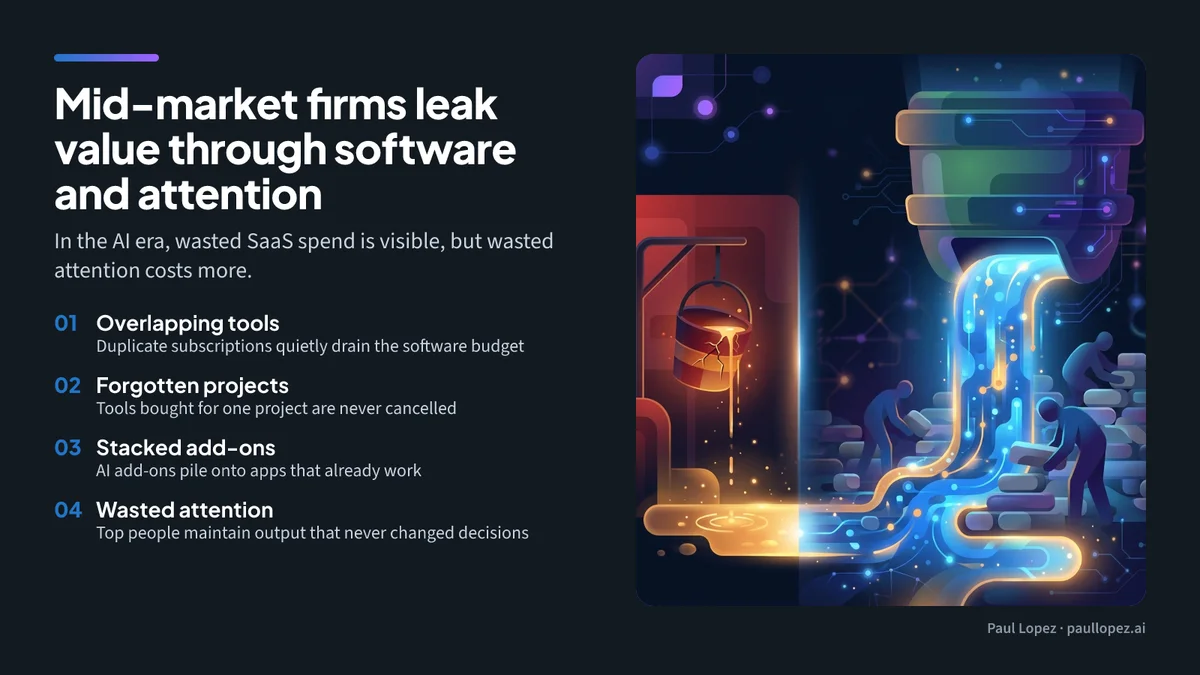
In the AI era, a mid-market company bleeds value in two places. The first is wasted SaaS spend: overlapping subscriptions, tools bought for one project and never cancelled, AI add-ons stacked on apps that already do the job. The second is wasted attention, the quieter and more expensive leak, where capable people spend their best hours reviewing, filing, and maintaining output that never changed a decision. The rest of this piece is about plugging both.
Four Questions That Separate Work From Theater
Start with the human work that happens after the agent finishes. The agent's minutes are not the cost. The cost is the reading, the judging, the deciding, and above all the recurring claim on someone's attention if the output becomes a standing report. Making work cheap to produce does not make it worth consuming.
Next, ask whether you are running more experiments than you commit to. The real gift of cheap agents is the ability to investigate a question you could never previously afford to ask, and then let most of those investigations go. The trap is treating every experiment as an obligation to ship. That habit converts cheap curiosity into a stack of half-built projects nobody has time to maintain.
Then decide when an assignment ends before you make it recurring. A recurring agent outlives its reason, keeps producing a report no one reads, and quietly burns the subscription while shaping the team's day around a question that stopped mattering months ago. Set stop conditions in advance. Make the agent earn its continuation.
Finally, protect attention on purpose. Whether the coordinating layer is you or a so-called chief-of-staff agent, its job is to prepare the few decisions that need a human and screen out the rest. Agents have infinite attention and never sleep. The people do not, which is the whole point.
These four questions are how a leader audits their own AI activity and finds the theater. The answers almost always point the same direction: do less, but do it better.
Where the Theater Hides: Three Mid-Market Industries
The pattern looks different by industry, but it always shows up. In Ramp's data, finance and insurance sits at 73.7% adoption and is the fastest-growing major sector, professional services ranks among the top three, and retail trade hit 49.9% in September after a 1.6-point jump in a single month. High adoption tells you who bought the tools. It says nothing about who redesigned the work.
Accounting, legal, and consulting firms live on drafting and reviewing documents, client intake, engagement letters, and research. The theater here is polished drafts nobody checks, plus a separate point tool for each step of the workflow. The intentional move is to consolidate routine drafting and intake onto the generative AI and automation already in the office stack. Then spend the freed attention on the judgment that protects the client: the clause the template misses, the number that changes the answer.
Insurance agencies, advisory shops, and regional lenders run on client onboarding, application and policy processing, and compliance documentation. The theater is a dashboard of AI activity that looks like diligence without being it. The intentional move is to automate document handling and triage while keeping a human firmly on every judgment that carries regulatory or suitability weight.
A well-formed output is not a correct decision, no matter how confident the formatting looks.
Mid-market merchants and brands handle customer support, product content, review responses, and order exceptions. This is the textbook SaaS-sprawl victim, with separate paid tools for helpdesk, email, reviews, and analytics that increasingly overlap with what the office stack plus automation can now do. The intentional move is to retire the overlapping subscriptions one workflow at a time. Bolting an AI agent onto each of twelve tools is not transformation; it is twelve new things to babysit.
In all three, the capability is the cheap part. The accuracy and the judgment remain the firm's own work, and choosing which workflows to consolidate is a design decision, not a procurement one.
Consolidate Onto the Stack You Already Own
Here is the move that turns the discipline into money. Most medium-sized companies already pay for a capable generative AI and automation layer and do not use it, because it came bundled with the office stack they bought for email and documents.
Microsoft 365 carries Copilot and Power Automate. Google Workspace carries Gemini, AppSheet, and Apps Script. The firm is often paying a second time, through a sprawl of third-party apps, for workflows the stack it already owns can now handle well enough.
The point is not to rip out every subscription and declare victory. It is to go workflow by workflow and ask an honest question of each paid tool: does the stack now do this job well enough that the specialist app is no longer worth its price, or is this one of the tools whose edge is real and tied to revenue. Retire the first kind. Keep the second.
Replacing tool sprawl with a pile of agents, or trading a capability that makes money for a tidier invoice, is just productivity theater with a cost-savings slide attached.
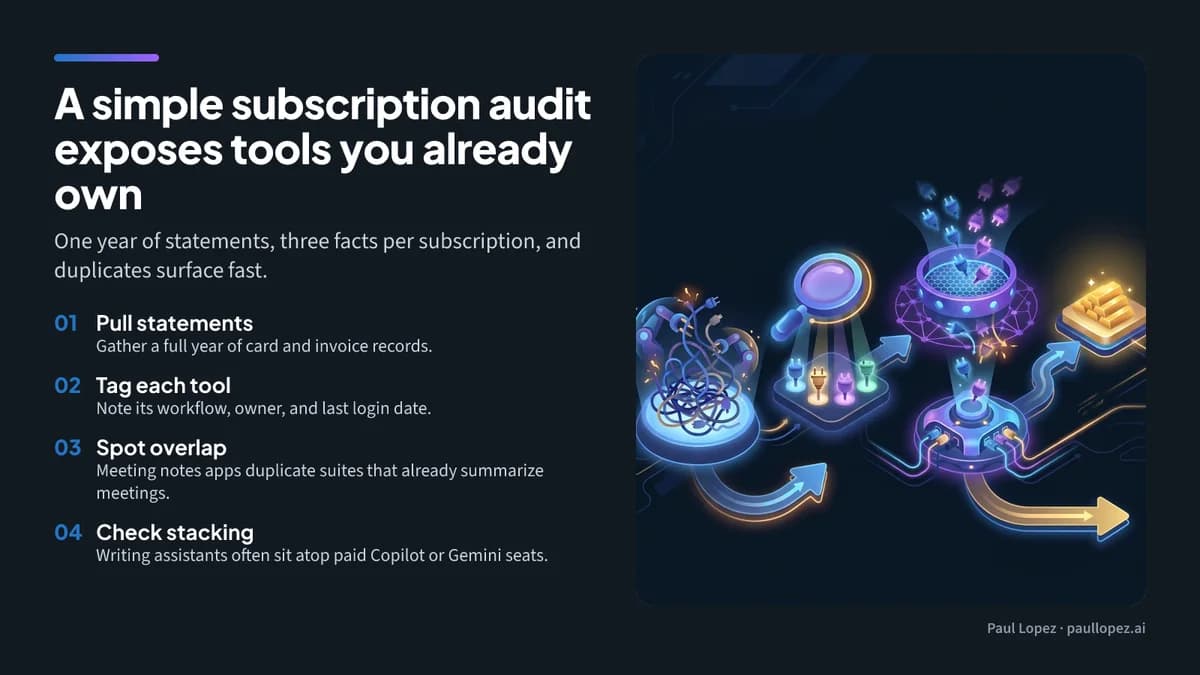
The audit itself is unglamorous. Pull a year of card and invoice statements, list every subscription, and attach three facts to each: the workflow it serves, the person who owns it, and the last time anyone logged in. The candidates surface fast. Think of a meeting-notes app licensed for a team whose suite already summarizes meetings, a standalone forms-and-approvals tool doing what Power Automate or AppSheet can route, or an AI writing assistant layered on top of a Copilot or Gemini seat the company already pays for.
The cheapest AI capability your company owns is probably the one already sitting unused in your email client.
Sometimes the built-in tool loses, and that outcome is fine. A helpdesk platform wired deep into the order system, a tax engine, or a legal research database often does a job the general-purpose assistant cannot match. The judgment is real, not automatic, and the test is whether the specialist edge shows up in revenue, risk, or client outcomes.
Whatever gets retired, redirect both dividends. The saved spend can fund the one or two specialist tools that earn their keep. The saved attention goes back to the people who were spending their afternoons managing logins, reconciling exports, and reading reports from tools nobody remembered buying.
The Limits Worth Admitting
Two cautions keep this from becoming a sermon against ambition. The first is that intentionality is not timidity. A medium-sized company trying to find an efficiency or a new line of business cannot afford to stop experimenting, and the cost of missing a real AI-driven advantage can easily exceed the cost of some wasted motion.
The discipline here explicitly includes running more cheap experiments, not fewer. The goal is to commit deliberately, not to do less for its own sake.
The second is that consolidating onto the office stack is a trade, not a free win. The generative AI built into Microsoft 365 or Google Workspace is often weaker than the best specialist tool it would replace, and leaning on one platform concentrates the firm's risk and its leverage in a single vendor. That is a reason to make the consolidation call one workflow at a time, keeping the specialist tool wherever its edge is real and tied to revenue, and never trading a capability that drives the business for a cleaner bill. Discipline that ignores either caution stops being discipline and becomes a different kind of theater.
Close
In Office Space the busywork was at least obvious, red staplers and all, while the AI version is polished, tireless, and billed monthly, which is exactly why you have to go looking for it. The market will keep selling more agents, more automations, and more AI subscriptions. More of all of it is not the same as more progress.
The firms that win with lean teams will be the ones that got clear-eyed about which activity was theater, consolidated onto the stack they already paid for, and spent their scarcest resource, attention, on the work that moved the business. Capability is no longer the constraint. Intentionality is, and no tool and no agent will supply it for you.