
Judgment Just Got Too Cheap to Meter for Banks
AI finally made Clippy's job worth doing—turning messy inputs into bounded decisions so cheaply that banks can afford judgment at every step. The catch: volume is solved; accuracy is still on you.
Judgment Just Got Too Cheap to Meter
A general-purpose classifier turns interpretation-to-decision into something an insurer or bank can afford to run everywhere. The cheapness is the invitation. The accuracy is the work.
Remember the talking paperclip in Microsoft Office, the assistant who thought he knew what you were trying to do? His whole job was classification: letter or memo, resume or report, and then he'd offer a template. Not what you wanted to say. Not how to say it well. Just one choice from a bounded set, and that was all. The feature became a punchline. A classifier that returns one of a few answers looks comically limited next to a system that can do anything.
But here is the thing the critics got wrong, or rather, the thing they got right by accident. The shape of that feature, complicated input, bounded output, is not a limitation. It is the most common and most valuable shape in real software. A claims photo that has to become a routing decision is a Clippy problem. An AML alert that has to become an escalate-or-pass is a Clippy problem. A broker submission that has to become an appetite-fit-or-decline is a Clippy problem. The punchline, it turns out, is the whole job.
What changed in September 2026 is that a cheap, general-purpose version of that shape arrived at scale. TypeSafe AI shipped Jev through the Vercel AI Gateway, the first classifier of this kind to be adopted broadly and at a price where volume is no longer the constraint. Jev makes interpretation-to-decision cost almost nothing, which lets a bank or an insurer put judgment almost everywhere. The only question that still costs anything is whether each of those judgments is right.
The Third Primitive
For most of computing history you had two ways to make software decide something. You wrote deterministic code for decisions you could state exactly, like flagging an invoice thirty days overdue, and you accepted that code could not read intent. When the decision required reading messy human text, whether a claimant sounds ready to leave, whether an email is a real opportunity or just contains the word opportunity, you reached for a language model and paid language-model prices to get back what was often a single word.
A general-purpose classifier is a third option, and it is narrower than a language model on purpose. It reads complicated input and returns one of a set of answers you defined, with a probability, and it never writes a sentence. That single constraint is what makes it fast and cheap, because the expensive part of a language model is the generation. Take the writing away and you are left with the judgment, delivered in a fraction of a second for a fraction of a cent.
Jev is the instance that made this concrete. TypeSafe AI shipped it on September 15, 2026, reachable through the Vercel AI Gateway as the model typesafe-ai/jev, and it does exactly one thing: it takes program state and a set of typed questions and returns Choices, Scores, and Booleans with probabilities attached. It is priced at $0.042 per million input tokens with output free, and it answers in well under a second. Within a day it reached roughly thirteen percent of Vercel paid AI Gateway teams, the fastest adoption in that gateway's history, which is less a verdict on one company than a signal that a great many builders had been waiting for exactly this shape.
Cheap judgment is not a curiosity. It is an architectural shift.
The three output types are concrete and useful at different scales. A Choice returns one option from a named set you define, which fits triage: total loss, repairable, or cash settlement. A Score rates against a rubric you specify, which fits prioritization: rank this alert on a fraud-risk scale of one to ten. A Boolean returns a probability from zero to one, which fits gating: does this proposed agent action require escalation to a human? Multiple questions evaluate in parallel within a single request, so a claims record can be scored on severity, dissatisfaction risk, and subrogation opportunity in one call.
TypeSafe reports Jev runs up to 193.6 times faster and 444.6 times cheaper than comparable LLM workflows on its own evaluations. These are vendor benchmarks, self-reported by members of the model team, and TypeSafe itself acknowledges the figures sit at the high end of what real deployments will see. The grounded number is Vercel's: swapping Jev into a production safety classifier in place of GPT-5.6 Luna ran that step five to eighteen times faster without rewriting any code. An 18x speedup on a single step in a pipeline does not deliver an 18x speedup on the whole pipeline, which is Amdahl's Law and worth keeping in mind. But it is still the kind of gain that changes whether you run the check on every item or only on the ones you can afford to review.
Where This Lands in Insurance and Financial Services
Insurance and banking are, underneath the regulation, enormous engines for turning complicated text into bounded decisions. A first notice of loss arrives as a paragraph and has to become a routing decision and a severity estimate. A submission arrives as a broker email with attachments and has to become a yes, a no, or a request for missing information. A transaction narrative has to become a flag for review or a pass. A customer message has to become an intent, a priority, and a team. None of these is the writing of prose. All of them are complicated in and simple out.
The scoping rule that holds across every use case here is the same one: the classifier routes, prioritizes, flags, and gates. It does not make the final regulated adjudication. That distinction is not a hedge; it is the design.
In claims, the immediate applications are FNOL triage and routing, where a first notice arrives as a paragraph and has to become a severity estimate matched to an adjuster tier. Carriers deploying agentic workflows report FNOL-to-triage times dropping from four to eight hours down to under five minutes. A classifier can score each inbound claim on severity and complexity and route it to the right handler, before a human touches it, because the choice between total loss, repairable, and cash settlement is a bounded Choice question that fits the primitive exactly. Beyond routing, a classifier can read claimant emails and call transcripts for dissatisfaction and attrition risk, flagging the customer who is about to leave before they actually leave. It can scan claim notes for subrogation opportunity and surface fraud signals for referral to a special investigations unit, never adjudicating the fraud itself.
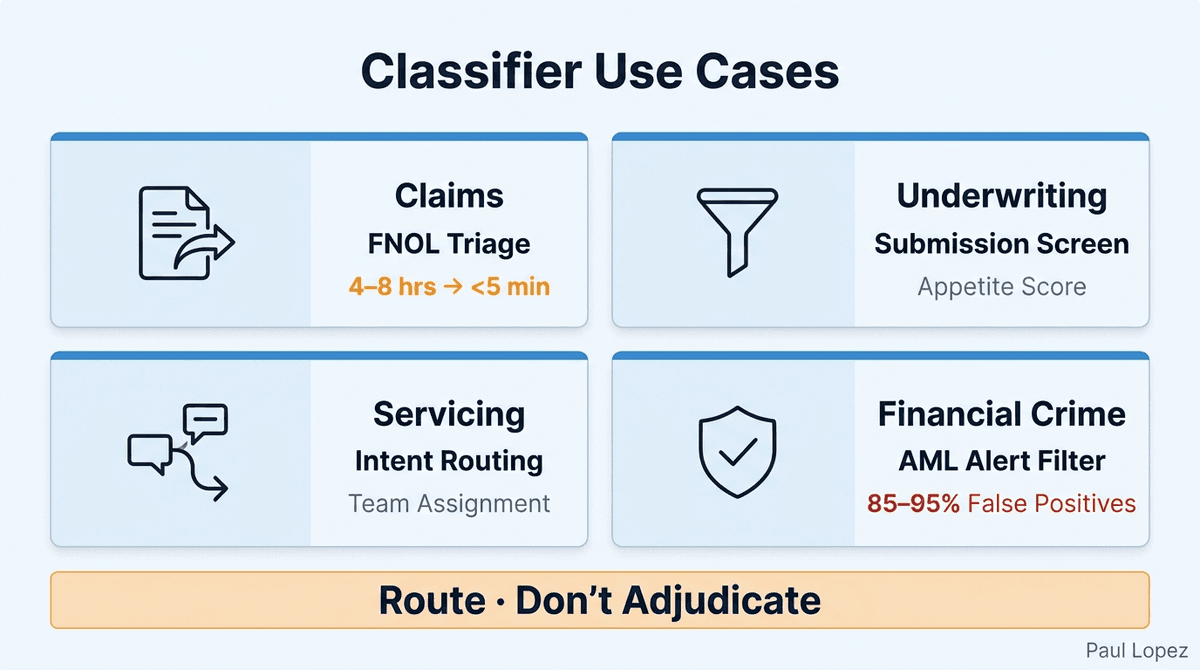
In underwriting, the use is about protecting underwriter time. A submission pre-screen can score an incoming broker package on appetite fit before an underwriter opens it. A completeness check can flag missing information on an application before it enters the queue, cutting the back-and-forth that slows everything down. A risk-flag extraction pass can surface the relevant signals from a loss run or broker correspondence and score them, so the underwriter's first read is already organized.
In servicing and distribution, intent classification routes broker, agent, and customer messages to the right team. Queue prioritization reorders inbound work by urgency and customer-risk rather than by arrival time, which is a simple change with meaningful operational impact.
In financial crime and compliance, the numbers make the case plainly. Between 85 and 95 percent of AML alerts are false positives, and compliance teams spend up to 90 percent of their time on alerts that lead nowhere. A classifier that scores each alert on risk and surfaces the top tier for human review does not replace the investigator; it lets the investigator spend time on the alerts that justify investigation. Know-your-customer document classification at onboarding and complaint categorization for conduct obligations follow the same pattern: high volume, bounded output, human review on the cases that warrant it.
The most consequential application, and the one that is newest in practice, is agent safety gating. As these firms deploy agents that can take real actions, issuing a refund, adjusting a reserve, moving money, sending a customer communication, a cheap classifier can sit in the outer loop of the agent and gate each proposed action with proceed, block, or escalate-to-human, applied at every step rather than once. This was previously too expensive to run at every step. At $0.042 per million tokens, it no longer is.
The judgments a firm rationed because each LLM call was too expensive can now run on every item, every day. The judgments it went without entirely are now affordable for the first time.
The Cheapness Is the Invitation, Not the Result
Here is the part the price tag hides. In an independent test of Jev on phishing detection, the classifier asked as a single broad question scored well below an ordinary small language model. Asked the same underlying question as several narrow ones, combined with weights fitted on the evaluator's own labeled examples, it reached about ninety-five percent and edged past the language model at a fraction of the cost. Same model, same task, two very different outcomes, and the only variable was the engineering.
That is the whole discipline in one result. A general-purpose classifier does not hand you accuracy at the sticker price. It hands you a cheap, fast substrate on which accuracy is built by decomposing a judgment into the narrow questions it is actually made of, weighting them against your own resolved outcomes, and shadow-evaluating the whole thing against your labeled decision log before a single live decision depends on it. The cheapness is what lets you run that evaluation on real volume for pennies. It is not a substitute for running it.
Narrow is not the limitation. Narrow is the design.
For a regulated operator, this means three moves in sequence, and skipping any of them is where the trouble starts. First, decompose. A broad judgment like "is this claim high severity?" is not a single question in practice. A human expert is actually asking several: Is the injury description consistent with a total loss? Are there coverage disputes present in the notes? Does the claimant mention legal representation? Each of those is a narrow question the classifier handles well. The broad question, asked as a single input, is what underperforms.
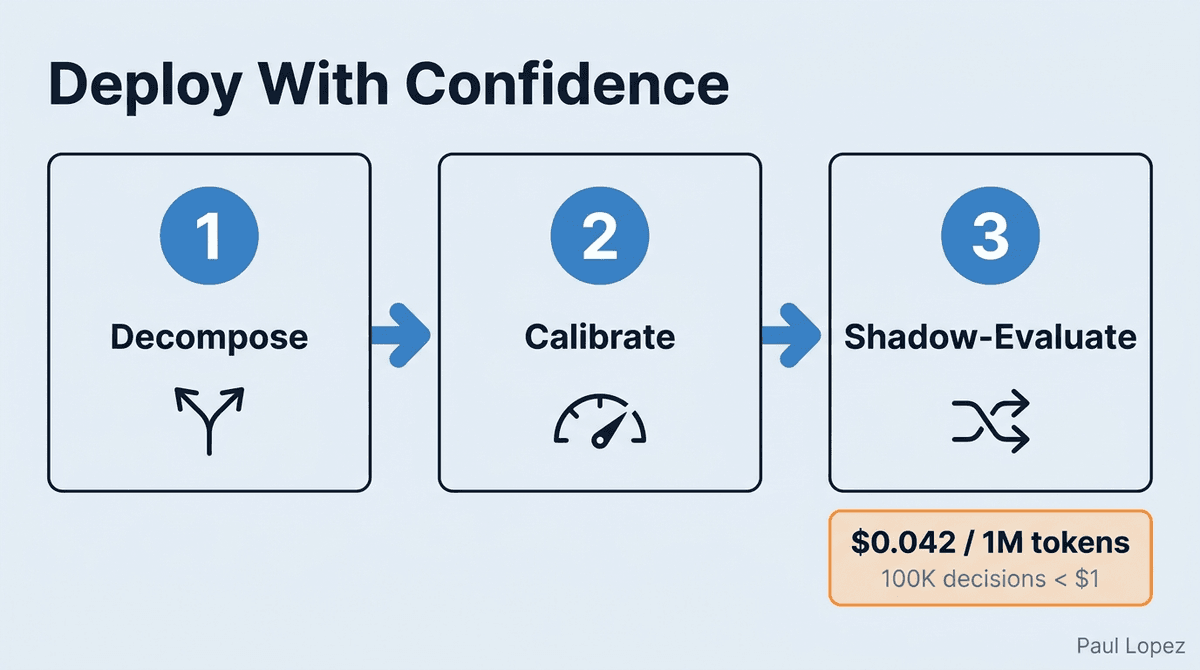
Second, calibrate on your own data. The probability that Jev returns is only useful if it is calibrated on your specific task and your specific population. Independent testing found calibration uneven across question types: a model can be overconfident on some questions and underconfident on others, which makes a threshold that looks defensible on a public benchmark unreliable in production. If you intend to act on a confidence threshold, you have to verify that threshold on your own labeled outcomes. A firm's resolved decision log is the only data source that makes calibration real.
Third, shadow-evaluate before cutover. Pull sixty to ninety days of labeled decisions. Run identical inputs through Jev alongside your current process. Measure accuracy, recall, false-positive rate, calibration, and cost on volume that represents your actual distribution. At $0.042 per million tokens, a hundred-thousand-decision shadow evaluation costs under a dollar. There is no credible reason to skip it, and there is no substitute for it. The shadow evaluation is where vendor benchmarks meet your data, and where the actual production number is determined. Only move live traffic once the shadow results justify it.
The Honest Limits
Two cautions belong on the table before anyone wires this into a regulated workflow. The first is that cheap does not mean safe. A well-formed decision that is wrong is still wrong, and in this domain a wrong classification can deny a valid claim, misroute a suitability concern, or wave through a transaction that should have been reviewed. Putting judgment everywhere means putting the possibility of a wrong judgment everywhere, and the answer is to place classifiers where the cost of an error is bounded and reviewable, and to keep humans on the adjudications where it is not.
The second is concentration risk. Jev is days old, from TypeSafe AI, a company that is months old, adopted fast during a promotional period whose durability no one can yet judge. Wiring a single new vendor into a load-bearing decision path, with no abstraction and no fallback, is a familiar way to turn a clever cost saving into an operational dependency. The mitigation is ordinary and worth stating: abstract the provider, keep a fallback path, and do not let the newest primitive in your stack become its newest single point of failure.
Neither caution is an argument against adoption. Together they describe the posture that makes adoption safe. Use the primitive widely for bounded, reviewable, high-volume judgments. Evaluate each placement on the firm's own labeled data before it touches live traffic. Keep humans on the high-stakes adjudications. Treat provider portability as a design requirement written into the architecture now, not negotiated after the dependency is load-bearing. A firm that does all of that has an advantage. A firm that skips the calibration step or abstracts nothing has a liability wearing the costume of an efficiency gain.
Close
The feature made Clippy the punchline. In your claims queue, in your onboarding flow, in every action an agent proposes, bounded classification is the most valuable question you were not asking, because until now you could not afford to ask it.
The model carries its name for a reason. Jevons paradox holds that making a resource cheaper does not reduce consumption; it expands it, because the economics unlock uses that were previously unthinkable. The AI decision bill a firm pays today reflects only the judgments it could previously justify at LLM prices. The real opportunity is the far larger set of judgments it skipped entirely because running them did not pencil out. That opportunity is now open. The shape to hunt for is complicated-in and simple-out. The primitive to run it is finally cheap enough to put everywhere. The accuracy that makes it safe to act on is the part that is still, and always, the firm's own work.