
Your 401k Becoming Exit Liquidity in AI IPO Wave
Retirement funds are about to become Silicon Valley's personal ATM as $3 trillion in AI companies prep historically massive IPOs.

When Your 401k Becomes Exit Liquidity: The Great AI IPO Wealth Transfer
Cerebras Systems just pulled off the largest U.S. tech IPO of 2026, raising $3.55 billion at $85 per share and watching it soar 70% on debut day. Investors are celebrating another AI hardware winner that breaks Nvidia's stranglehold. But here's what the victory lap headlines missed: this is just the warm-up act for the largest wealth transfer from retail investors to Silicon Valley insiders in market history.
The Cerebras success story isn't about disrupting AI chips. It's about proving that desperate investors will pay almost any price for AI exposure. And three companies worth a combined $3 trillion just took notice. They're planning IPOs that will make Cerebras look like a yard sale, and your retirement account is about to become their exit strategy.
The $170 Billion Problem Nobody's Talking About
While markets celebrated Cerebras's $10 billion valuation, the real story is happening behind closed doors. SpaceX, OpenAI, and Anthropic are preparing to go public between late 2026 and early 2027, planning to raise a combined $170-195 billion. To put that in perspective: all U.S. IPOs in 2025 raised $47 billion total, and that was considered a banner year.
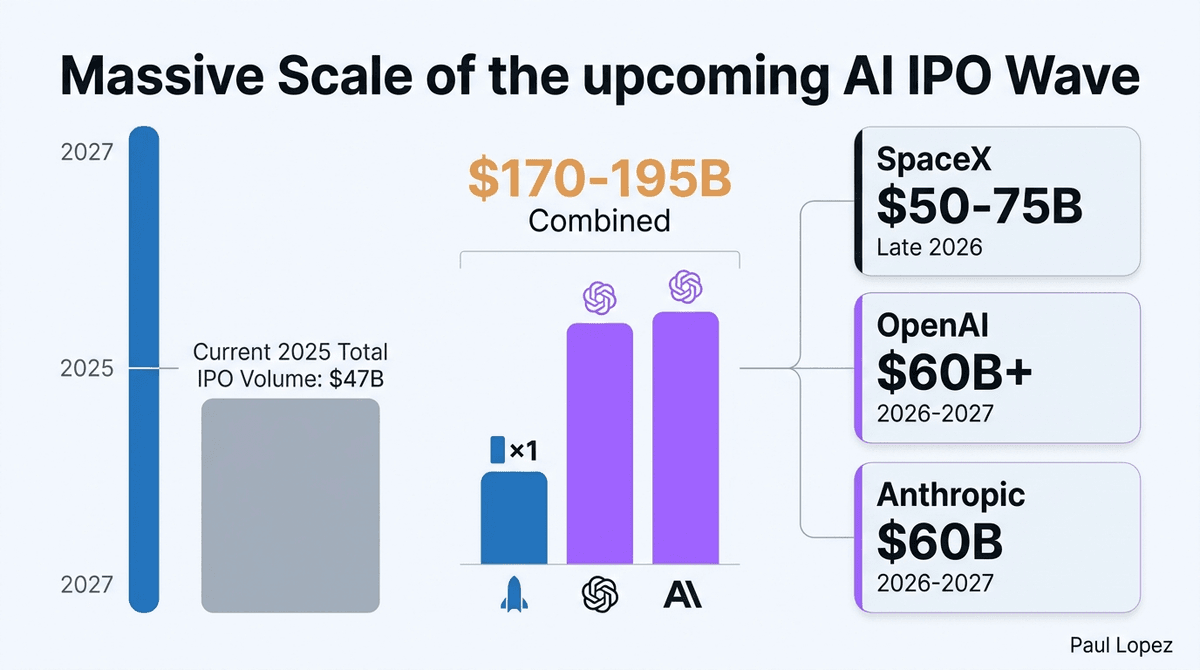
SpaceX alone wants to raise $50-75 billion in what would be the largest IPO in history. OpenAI is targeting $60+ billion, while Anthropic eyes another $60 billion. The numbers don't add up, as they used to say on Beavis and Butt-Head. But these companies have discovered something more reliable than market fundamentals: they can manufacture scarcity.
Here's the trick that makes Cerebras look quaint. Traditional IPOs float 15-25% of company shares to the public. SpaceX plans to float just 3.3% of its shares. Imagine a restaurant with 10 seats, 10,000 customers, and a doorman taking bribes to skip the line. That doorman? He's your index fund manager, and he's legally required to pay whatever it takes.
Gaming the Index Fund System Like a Vegas Casino
The real genius isn't in the AI technology. It's in exploiting rule changes that turned America's retirement system into a guaranteed buyer program. On May 1st, 2026, Nasdaq quietly updated its inclusion rules. Companies can now join the Nasdaq 100 index after just 15 trading days, down from the previous 1 month to 1 year waiting period.
SpaceX reportedly made fast-track index inclusion a condition for choosing Nasdaq over the NYSE. Smart move. When you're added to the Nasdaq 100, you're weighted by your total market cap, not just the shares actually available for trading. SpaceX's $1.75 trillion valuation means massive index weighting, but only 3% of shares will exist for trading.
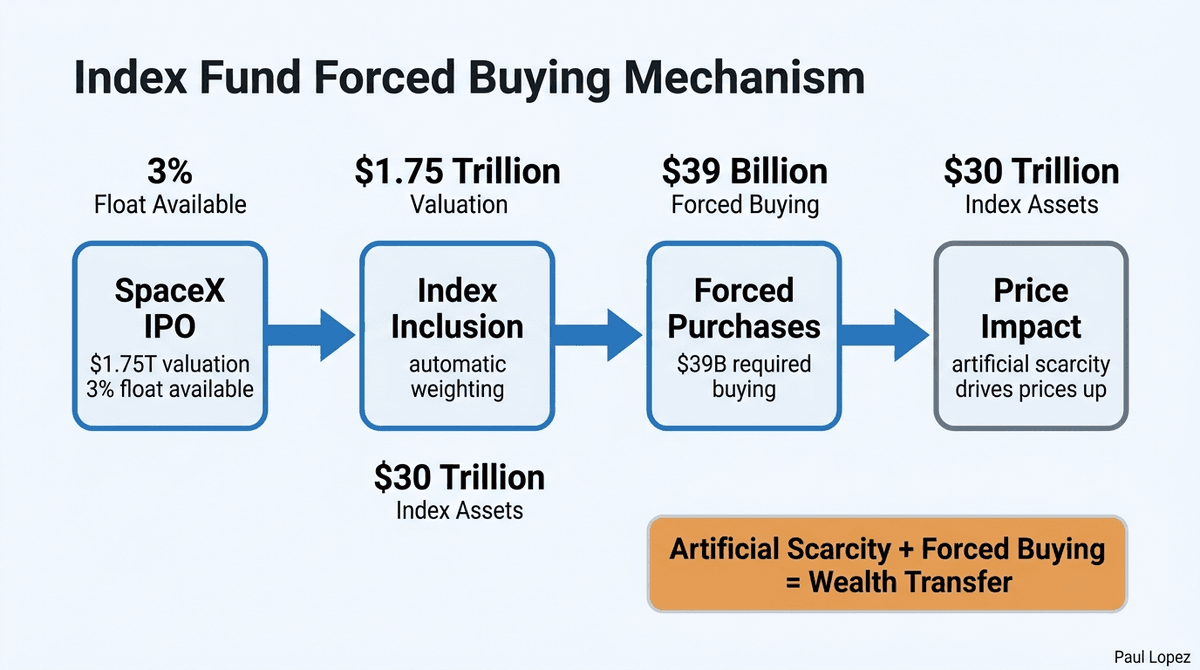
Bloomberg Intelligence estimates this will trigger $39 billion in forced index fund purchases within weeks of the IPO. That's $30 trillion in index fund assets legally required to buy whatever shares exist at whatever price the market demands. Your 401k, your pension, your target-date funds: they all become automatic bidders in an auction with almost nothing for sale.
The Succession vibes are strong here. Logan Roy would appreciate the elegance: create artificial scarcity, force institutional buyers to compete, then sit back while retirement accounts provide liquidity at inflated prices.
The Lock-Up Expiration Trap
But wait, there's more, as they used to say on late-night TV commercials. Those 3.3% of shares available at IPO? They're joined by the other 97% when lock-up periods expire 3-6 months later. Early SpaceX investors from 2020 are sitting on 38x returns at current valuations. When they can finally sell, the supply dynamics flip overnight.
Pitchbook analysts predict 20-30% stock swings on any significant news due to the tiny float. That's during the scarcity phase. When lock-ups expire and 97% more shares hit the market, those same index funds that were forced to buy during the shortage may need to sell during the flood.
The pattern repeats across all three companies. OpenAI insiders who bought shares at early valuations get to cash out into index funds buying at peak prices. Anthropic follows the same playbook six months later. It's a perfect wealth transfer mechanism disguised as innovation investing.
The Financial Reality Behind the Hype
Here's what makes this particularly concerning: the companies orchestrating this transfer aren't exactly printing money. OpenAI is projected to lose $14 billion in 2026 with a $57 billion annual cash burn by 2027. They have 18-24 months of runway left despite raising over $100 billion. No profitability is expected until 2030.
The much-hyped Stargate infrastructure project? Traditional banks refused to finance the $500 billion version. It's been scaled back from $1.4 trillion to $600 billion, and even that's mostly aspirational. Anthropic's $6.4 billion in projected 2026 revenue may largely consist of cloud computing credits rather than actual cash income.
These aren't victory lap IPOs celebrating sustainable businesses. They're emergency funding rounds with better marketing. The difference is that emergency funding rounds price in risk. IPOs marketed to retail investors through index funds don't.
Healthcare Gets Caught in the Crossfire
Healthcare organizations betting on AI transformation face particular exposure. Hospital systems and health insurers have poured money into AI-focused investment vehicles, often through pension funds that automatically track major indices. When these AI IPOs hit, healthcare's retirement systems become unwilling participants in the wealth transfer.
The irony is thick. Healthcare organizations desperately need AI solutions for clinical decision support, administrative efficiency, and patient care optimization. But their retirement funds may end up subsidizing valuations that have little connection to actual healthcare utility or sustainable business models.
Making It a Deliberate Choice
The Cerebras IPO proved that AI investor appetite is essentially unlimited. A $10 billion valuation for a chip company that remains a rounding error compared to Nvidia doesn't reflect careful financial analysis. It reflects FOMO and artificial scarcity creating their own reality.
What's coming next is the same dynamic, but with 17 times more capital involved and your retirement security as the backstop. Index funds holding trillions in American retirement dollars are about to become the exit liquidity for Silicon Valley's largest-ever insider cash-out event.
The system works exactly as designed. The question is: designed for whom? When 97% of a company's shares unlock after your index fund was forced to buy during artificial scarcity, that's not market efficiency. That's wealth transfer with extra steps.
Your move is simple: know what's happening and make it deliberate rather than automatic. The doorman is already taking bribes. At least make sure you know what table you're buying.
References
- Financial Research Analysis - Frontier Model Labs and SEC documents
- Bloomberg Intelligence: Index fund purchase projections and market impact analysis
- Pitchbook: Low-float IPO volatility predictions and historical comparisons
- Nasdaq Rule Changes: May 1st, 2026 fast-track index inclusion requirements
- Company Financial Projections: OpenAI cash burn, Anthropic revenue composition, SpaceX valuation timeline