
Generic AI Dies as Trillion Dollar Agentic Workflows Transform Business
Generic software promised efficiency; AI agents deliver obsolescence by swallowing entire workflows whole.
The Death of Generic AI: Why Trillion-Dollar Agentic Workflows Are Killing SaaS
Remember when every SaaS product claimed to solve everything for everyone? That era just died, and AI pulled the trigger.
For years, enterprise software operated on the "tastes like chicken" principle. Salesforce, ServiceNow, Workday: they all promised the same generic efficiency gains with minor customization around the edges. Companies bought into the myth that business processes could be standardized, that one size fits all if you squint hard enough.
That illusion is over. AI agents don't want to be your next subscription dashboard. They want to own entire workflows, end to end. And suddenly, three massive forces are converging to create what might be the largest B2B opportunity in history: trillion-dollar agentic workflows that make traditional SaaS look like expensive digital paperweights.
The Perfect Storm: PE Panic Meets AI Reality
Private equity firms are staring down the barrel of their own investments. Those SaaS companies they loaded up on over the past decade? AI just turned them into stranded assets faster than you can say "multiple compression." When an AI agent can handle customer support tickets from intake to resolution, why pay for a helpdesk platform that requires three human handoffs and two system integrations?
The numbers tell the story. Anthropic just announced a $1.5 billion deployment company backed by Blackstone, Hellman & Friedman, and Goldman Sachs. OpenAI is pursuing similar ventures valued near $10 billion. These aren't product companies anymore. They're implementation engines designed to capture the value that generic software can no longer deliver.
Meanwhile, hyperscalers like OpenAI and Anthropic have discovered something uncomfortable: despite massive fundraising rounds, they're capital-constrained when it comes to enterprise deployment. Building frontier AI models is expensive. But actually implementing them across Fortune 500 workflows? That requires armies of forward-deployed engineers who understand both the technology and the byzantine reality of enterprise business processes.
Enter private equity as the unlikely savior and distribution channel. PE firms control portfolios of companies desperate for AI transformation, and they have the capital to fund custom implementations across entire sectors simultaneously.
Four Horsemen of the SaaS Apocalypse
The destruction is coming from four directions at once, and traditional software companies are caught in the crossfire.
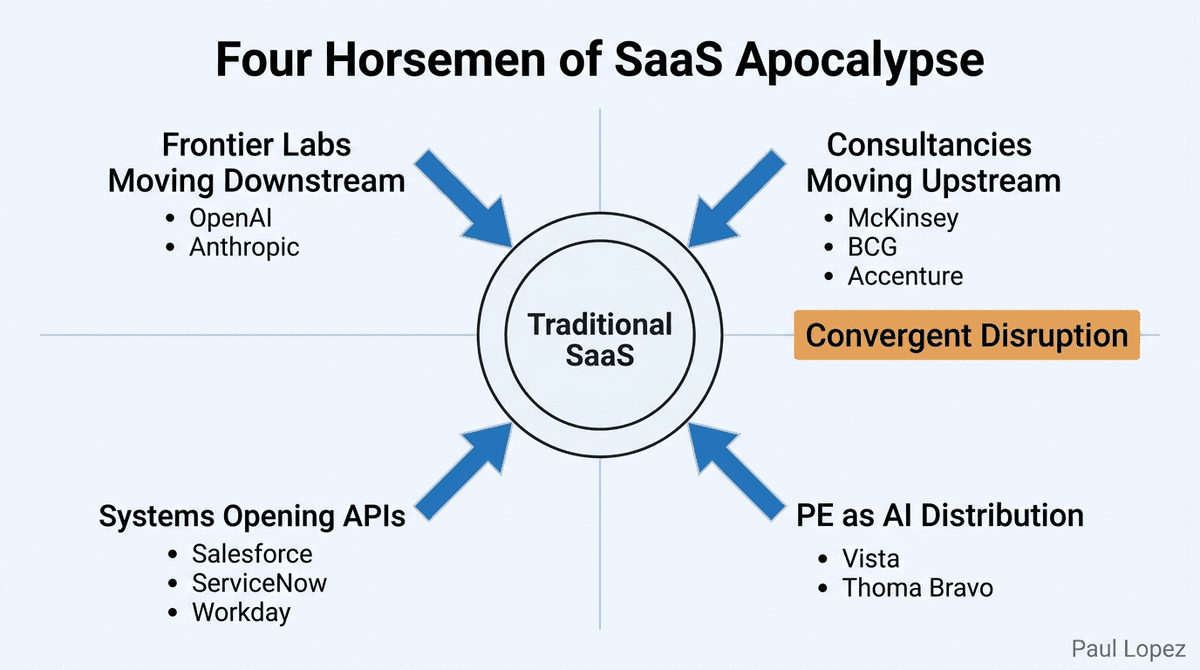
First, frontier labs are moving downstream. AI companies aren't content to provide APIs anymore. They're going after specific use cases with purpose-built solutions. When Claude starts competing directly with Figma through Claude Design, you know the gloves are off. The hyperscalers have realized that the real money isn't in selling intelligence. It's in selling completed work.
Second, consultancies are moving upstream. McKinsey, BCG, and Accenture just joined OpenAI's Frontier Alliance. These aren't partnerships. These are acquisitions by another name. Management consulting firms are building serious engineering capabilities because they've figured out that strategy recommendations without implementation capability are worthless in an AI world.
Third, systems of record are opening the gates. Salesforce, ServiceNow, and Workday are exposing APIs specifically designed for AI integration. They can see the writing on the wall. Better to become the data layer for AI workflows than to become irrelevant entirely.
Fourth, private equity has become the distribution channel for AI transformation. When a PE firm controls 20 healthcare companies, deploying the same agentic workflow across all 20 creates immediate economies of scale that make custom implementation economically viable.
Where the Real Value Hides: The Implementation Layer
Here's what most AI coverage misses: the intelligence isn't the valuable part anymore. The trillion-dollar opportunity lives in the implementation layer, in the unglamorous work of making AI agents actually function within real business contexts.
The value stack breaks down into six critical components that can't be genericized:
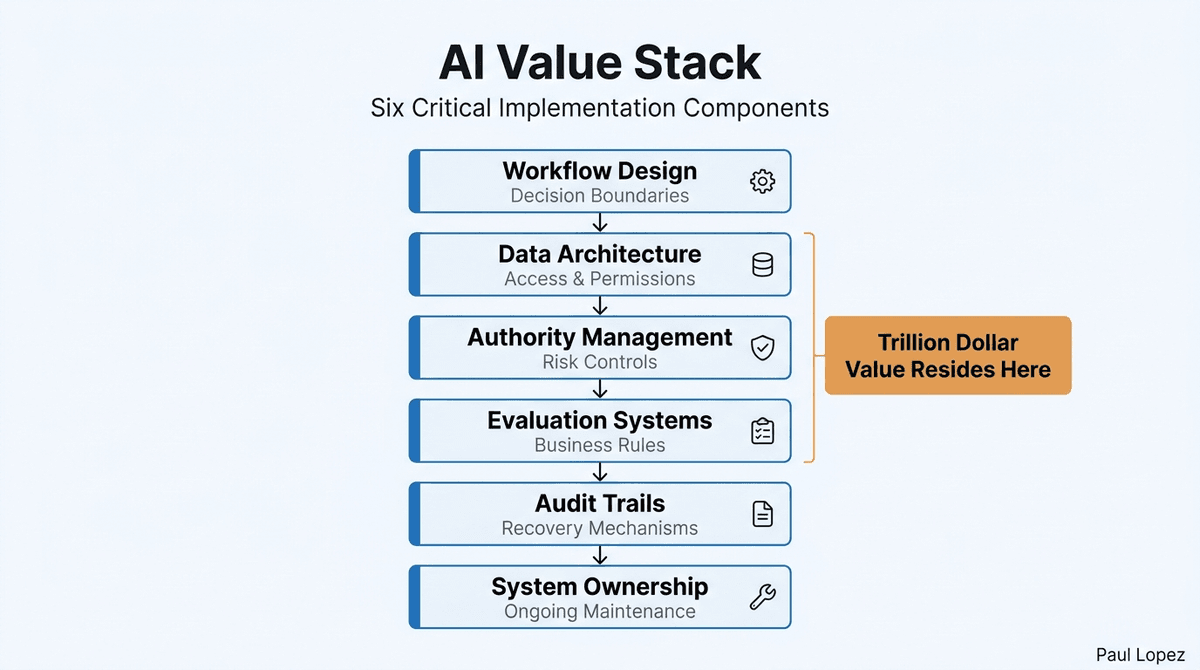
Workflow design and decision boundaries. When does the AI agent escalate to a human? What approval thresholds trigger different processes? These decisions are unique to every organization and often every department within that organization.
Data access and permissions architecture. An AI agent handling insurance claims needs different data access than one processing loan applications, even within the same financial services company. The permission structures are byzantine and company-specific.
Authority and risk management. What spending limits does the AI have? What contracts can it approve? What customer promises can it make? These parameters vary wildly based on industry, company size, regulatory environment, and risk tolerance.
Evaluation and business rule systems. How do you measure whether an AI agent is following company policies correctly? The evaluation frameworks need to understand not just accuracy, but compliance with internal procedures that may have evolved over decades.
Audit trails and recovery mechanisms. When the AI agent makes a mistake, how do you trace the decision tree? How do you recover? What human oversight is required? These systems need to integrate with existing compliance and risk management frameworks.
Ongoing system ownership and maintenance. Who monitors the AI's performance? Who updates it when business processes change? Who handles edge cases and exceptions? This isn't a "set it and forget it" deployment.
The Custom vs. Generic Battle Royale
This is why generic AI wrapper companies are walking dead. They're building solutions that assume business processes can be standardized, when the opposite is true. The companies that will win are those that "sit closer to the business object," understanding the specific workflows, edge cases, policies, and entitlements that make each enterprise unique.
Take customer support as an example. A generic AI chatbot handles maybe 60% of inquiries adequately. An agentic workflow designed specifically for a healthcare provider's patient support system handles insurance verification, appointment scheduling, prescription refills, and billing inquiries as a complete process. It knows the difference between urgent symptoms that require immediate escalation and routine questions that can be resolved through patient portal integration.
The difference isn't in the underlying AI. It's in understanding that healthcare patient support workflows are fundamentally different from SaaS customer success workflows, even though both involve humans asking questions and expecting answers.
The Implementation War Ahead
We're looking at the largest B2B opportunity in history precisely because it can't be solved with generic solutions. Every Fortune 500 company needs custom AI implementation across dozens of workflows. Every workflow requires deep understanding of industry-specific processes, regulatory requirements, and organizational quirks that have accumulated over decades.
The math is staggering. Trillions of dollars in workflow automation, but only if you can build the custom fabric that makes it work within existing business contexts. This isn't about replacing humans with AI. It's about replacing generic software with intelligent processes that actually complete work instead of just organizing it.
The opportunity is "wide open" for entrepreneurs who understand that implementation detail is now the competitive moat. The companies that win won't have better AI. They'll have better understanding of how work actually gets done in specific industries, and they'll build the custom infrastructure to make AI agents effective within those contexts.
The New Reality: Implementation Is Everything
Traditional SaaS is dead. Long live agentic workflows.
The question isn't whether AI will transform enterprise software. It's whether your company will be the one doing the transforming or getting transformed. The winners will be those who recognize that generic solutions just became worthless, and custom implementation just became everything.
For enterprise buyers: start asking AI vendors not what their models can do, but how they plan to integrate with your specific workflows, compliance requirements, and business processes. The demo that impresses you is worthless if it can't handle your edge cases.
For AI builders: stop building wrappers. Start building implementations. The value is in understanding business contexts deeply enough to automate complete processes, not just individual tasks.
For investors: evaluate AI companies on their implementation capabilities, not their model performance. The companies with forward-deployed engineers who understand enterprise workflows will capture the trillion-dollar opportunity. The ones with better APIs will get commoditized.
The implementation war has begun. Choose your battlefield carefully.