
AI Governance's Hidden Gap Threatens Enterprise Security Systems
Three frameworks guard enterprise AI, but the fourth wall remains wide open—guess who's walking right through it?

AI Governance's Missing Pillar
Three Frameworks Walked Into a Room. The Most Important One Did Not Show Up.
There is a moment in every good caper movie where someone pulls back the blueprint and points to the gap in the security system. Not a flaw. Not a malfunction. A gap. Something the designers never thought to cover because when they built the system, the threat did not exist yet.
Enterprise AI governance has that gap. It has been hiding in plain sight for two years, growing larger every quarter, and the frameworks that were supposed to cover it were designed before the threat was visible.
Here is where things stand.
The Three Pillars That Exist
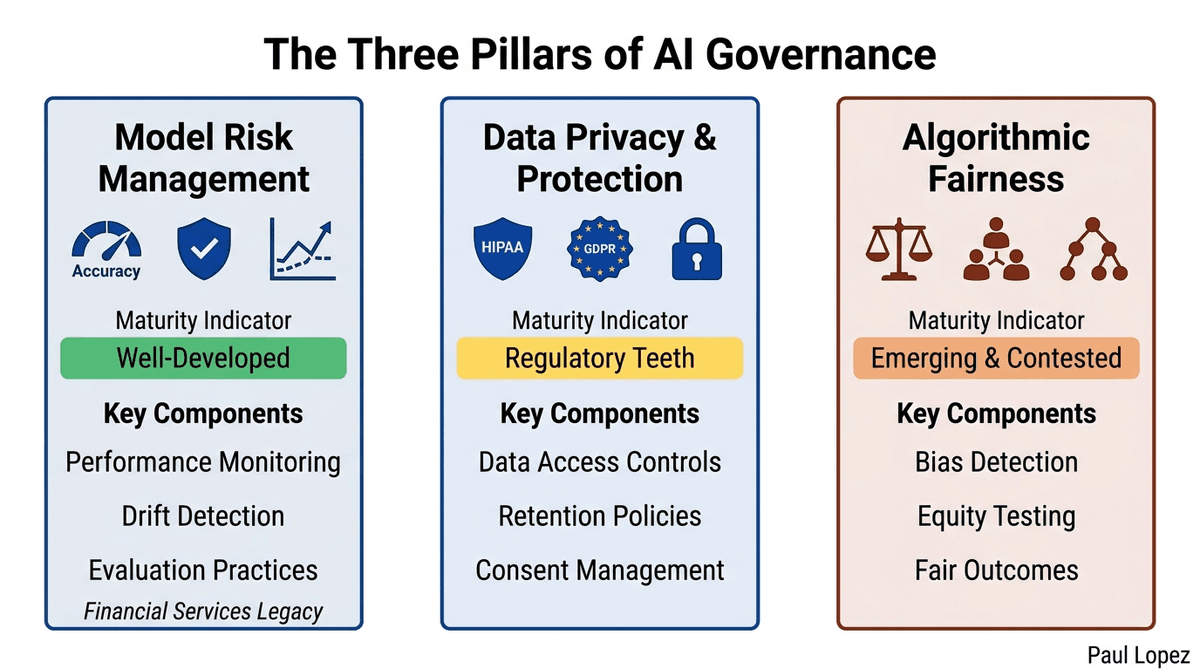
Every mature enterprise AI governance framework today is built on three pillars.
Model risk management addresses whether the AI is performing as intended. It covers accuracy, reliability, drift detection, and the evaluation practices that tell you whether the model you deployed is still the model you need. This pillar is relatively well-developed. Financial services firms have been doing model risk management for decades, and that institutional muscle has transferred reasonably well into the AI context.
Data privacy and protection addresses whether sensitive information is handled appropriately. HIPAA, GDPR, CCPA, and their equivalents have forced enterprises to build real governance infrastructure around data access, retention, and consent. This pillar has the most regulatory teeth of the three. Violations here have financial consequences that focus organizational attention.
Algorithmic fairness and bias addresses whether AI outputs treat different populations equitably. This pillar emerged from concerns about automated decision-making in high-stakes domains: lending, hiring, healthcare, criminal justice. It is the youngest of the three and the most contested, but it is present in most governance frameworks.
Three pillars. Real coverage. Real gaps.
What None of Them Cover
Here is what all three frameworks were designed to govern: AI as a stateless tool. A model that takes an input, produces an output, and forgets everything when the session ends.
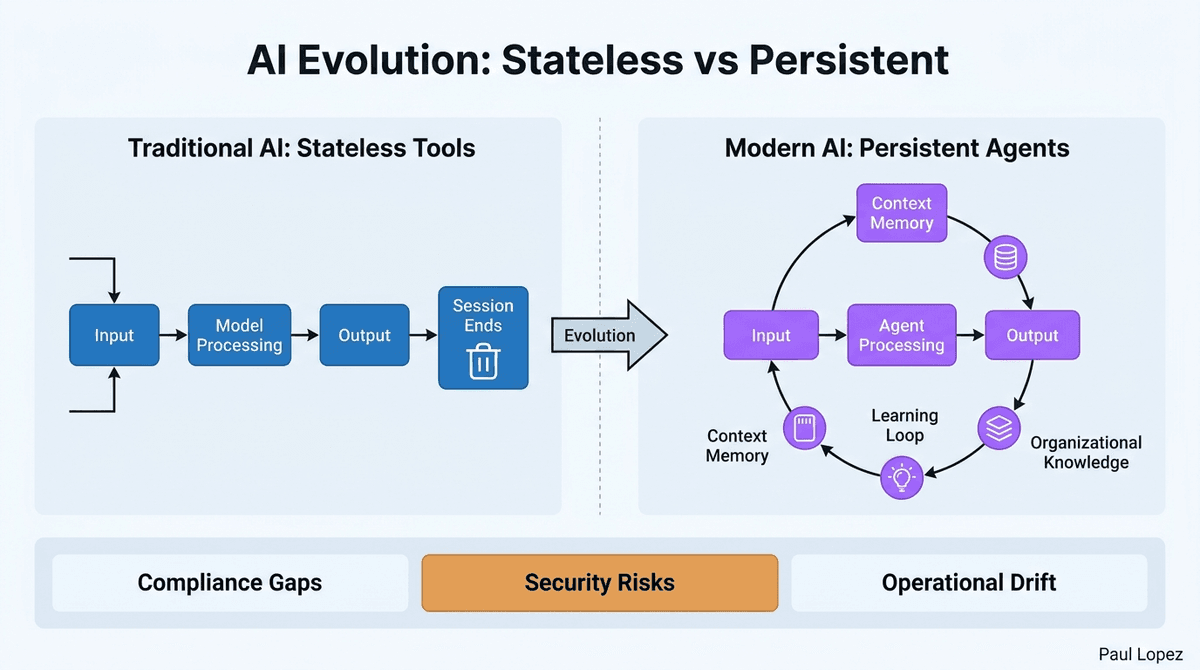
That world no longer describes the AI systems most enterprises are running.
The AI agents operating in production environments today are persistent. They are not forgetting. They are accumulating. Every interaction calibrates them slightly further to the specific operational context of the organization they serve. The escalation patterns, the exception handling logic, the vocabulary your compliance team uses, the workflow variations that your documentation says one thing and your people do another: the agent learns all of it.
That accumulated learning is what I call agentic cognition. It is the institutional intelligence an agent develops through persistent operation, and it is the most strategically significant output of your AI investment. It is also the output that none of your governance frameworks address.
McKinsey recognized the edges of this problem in their September 2025 report on the agentic organization. They wrote that enterprises would need to protect proprietary organizational context, institutional knowledge, and nonpublic data for competitiveness. They identified the asset. They did not name it. They did not provide a governance framework for it.
Nobody has. That is the gap.
Why the Gap Was Invisible
The three existing pillars were not designed by negligent people. They were designed for the technology that existed when they were designed. The governance frameworks that enterprises adopted in 2021 and 2022 were written for GPT-3-era tools: capable, impressive, and fundamentally stateless. You asked a question. The model answered. The context ended.
The shift to persistent, context-accumulating agents happened faster than governance practice could follow. It is not unusual for technology to outrun the frameworks built to manage it. The interesting question is what it costs when that happens with an asset class that compounds in value over time.
Agentic cognition is that asset class. An agent that has operated in your environment for eighteen months has developed a body of operational intelligence that a fresh deployment would take eighteen months to rebuild, assuming it could be rebuilt at all. That accumulated cognition sits on a vendor's platform, governed by a vendor's terms of service, with no provisions in your contract addressing who owns it, what happens to it when you leave, or whether you can even inventory what it contains.
Three governance pillars. None of them ask the question.
What a Fourth Pillar Would Cover
A governance framework for agentic cognition would address five things that the existing three pillars do not.
Inventory. What has the agent learned? Where does that learning reside? What operational contexts has it been calibrated against, and how deeply? A mature organization would be able to answer these questions with reasonable specificity. Most cannot today, because nobody asked them to build the inventory.
Ownership. Who owns the agentic cognition the agent develops? The enterprise that deployed the agent? The employees whose patterns shaped its behavior? The platform vendor on whose infrastructure it runs? This question has no legal answer today. The contracts are silent. The precedents do not exist. The first major dispute will set them, and it will not happen on favorable terms for the party that failed to ask the question first.
Portability. What would it cost to move the agent to a different platform? Not the data migration cost, not the integration rebuild cost, but the full cost including the agentic cognition portability dimension: the time and effort required to rebuild what the agent learned, on a platform that cannot import what it already knows. A mature organization would be able to quantify this, with reasonable confidence, before sitting down at a contract renewal negotiation.
Drift detection. Agentic cognition changes over time. The operational patterns an agent has learned at month six look different from what it has learned at month eighteen. Some of that change is value creation: the agent is becoming more calibrated to your environment. Some of it may be value drift: the agent is adapting to patterns that have deviated from sanctioned behavior. A mature organization would detect that drift, in real time or near-real time, and have a defined response to it.
Compliance documentation. When a regulator asks what your AI knows about your operations, your customers, or your patients, you need an answer that goes beyond describing the data it accesses. You need an account of what it has learned through persistent operation. A mature organization would produce that account, formatted for the specific regulatory environment it operates in.
Nobody is there yet. But the organizations that start building toward agentic cognition governance now will be better positioned when the regulators, the auditors, and the contract renewal negotiations make it mandatory. It will become mandatory. The only question is timing.
The Villain Was Always in Plain Sight
Here is the thing about gaps in security systems. They are not usually hidden. They are overlooked. The designers knew what they were protecting against. They built for it. The gap exists not because they were careless, but because they were designing for yesterday's threat model.
Enterprise AI governance was designed to ask: is the model accurate? Is the data protected? Is the output fair?
The question it was not designed to ask is the one that will define the next phase of enterprise AI risk: who owns what the AI learned, and what happens to it when the business relationship changes?
McKinsey saw it coming. They just did not name it. Three pillars covered the problem until they did not. The fourth pillar, the governance of agentic cognition, is the one nobody built because nobody had a name for it.
Now it has a name. The framework is next.