The New Art of Managing AI Workforces
Where humans and AI agents work as teammates, your management playbook just got a complete rewrite.

From Team Lead to Agent Whisperer: The New Art of Managing AI Workforces
Picture this: six months ago, you learned how to prompt ChatGPT effectively. Today, that skill is about as valuable as knowing how to operate a dial-up modem. Welcome to the world of frontier operations, where every AI management technique has the shelf life of a TikTok trend, but the stakes keep getting higher.
Here's the counterintuitive reality that's reshaping leadership: as AI capabilities expand in an ever-growing bubble, they don't reduce the need for human oversight. They create more opportunities for it. Think of it like managing a hockey team where the rink keeps expanding every quarter, and you need to constantly reposition players while the game is in motion.
The companies figuring this out first aren't just gaining a competitive edge. They're building compound advantages that will define the next decade of business. Because while everyone else is debating whether AI will replace workers, the smart money is learning how to manage teams where humans direct dozens of AI agents simultaneously.
The Five Skills That Didn't Exist Last Year
Managing agent teams requires a completely new operational framework. Unlike traditional management skills that evolved over decades, these capabilities have emerged in the past 18 months and expire faster than your LinkedIn certifications.
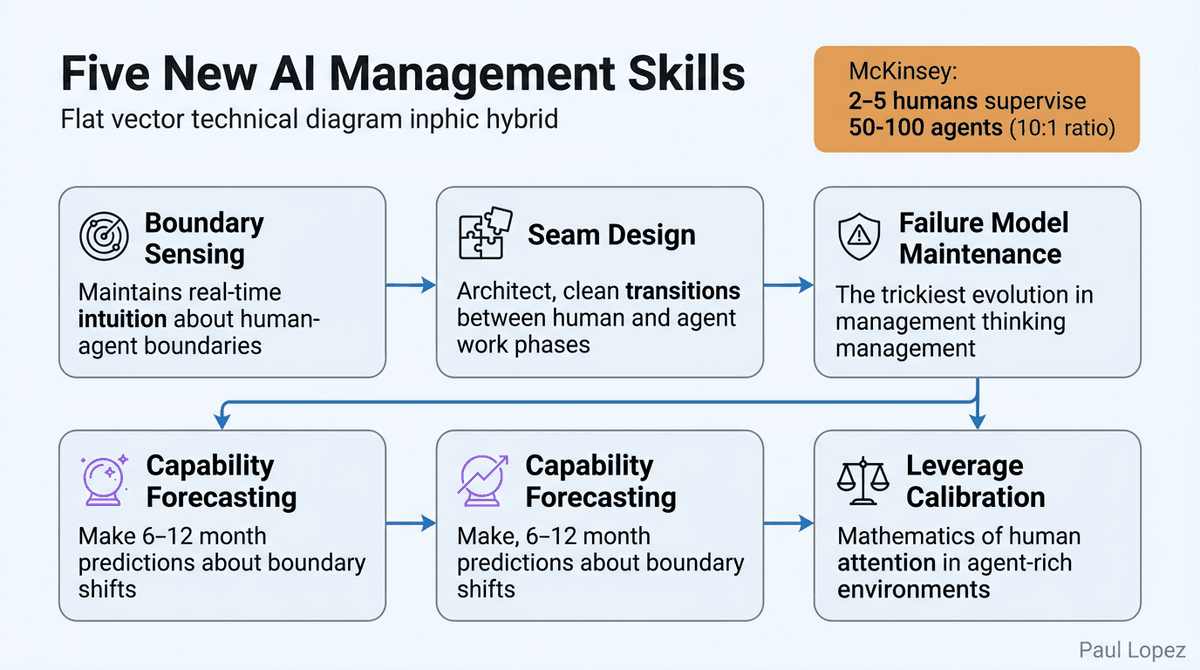
Boundary Sensing is the art of maintaining real-time intuition about where human-agent boundaries sit for your specific domain. A product manager might let agents handle market sizing and feature comparisons while reserving stakeholder dynamics for human judgment. But here's the catch: this calibration needs updating with every model release. What required human oversight in GPT-4 might be fully delegatable in Claude 3.5, creating a quarterly skill expiration cycle that makes continuing education look quaint.
Seam Design involves architecting clean transitions between human and agent work phases. A software engineering lead might structure handoffs so agents handle ticket triage while humans tackle architectural decisions. The key insight? These seams require continuous redesign as capabilities shift. The workflow that worked perfectly in January becomes inefficient by April when agents gain new reasoning capabilities.
Failure Model Maintenance represents perhaps the trickiest evolution in management thinking. Early AI models failed obviously with garbled text or wrong facts. Current models fail subtly, delivering 98% accurate research with 2% confidently fabricated content that can torpedo entire projects. A corporate counsel might know agents excel at catching boilerplate issues but consistently miss indemnification clauses. Maintaining these differentiated failure models by domain becomes a core competency.
Capability Forecasting requires making 6-12 month predictions about boundary shifts. It's like reading swells on the ocean rather than linear prediction. Seeing coding agents gain 30-minute autonomy suggests investing in code review skills rather than raw coding capabilities. The managers who nail these forecasts position their teams ahead of capability jumps instead of scrambling to catch up.
Leverage Calibration tackles the mathematics of human attention in agent-rich environments. McKinsey research suggests 2-5 humans can effectively supervise 50-100 agents, roughly a 10:1 ratio. An engineering manager might create hierarchical attention allocation where most code flows through automated tests, but architectural decisions get deep human engagement. It's attention triage at unprecedented scale.
The New Organizational Architecture
Two distinct structures are emerging for agent team management, each optimized for different scenarios and talent availability.
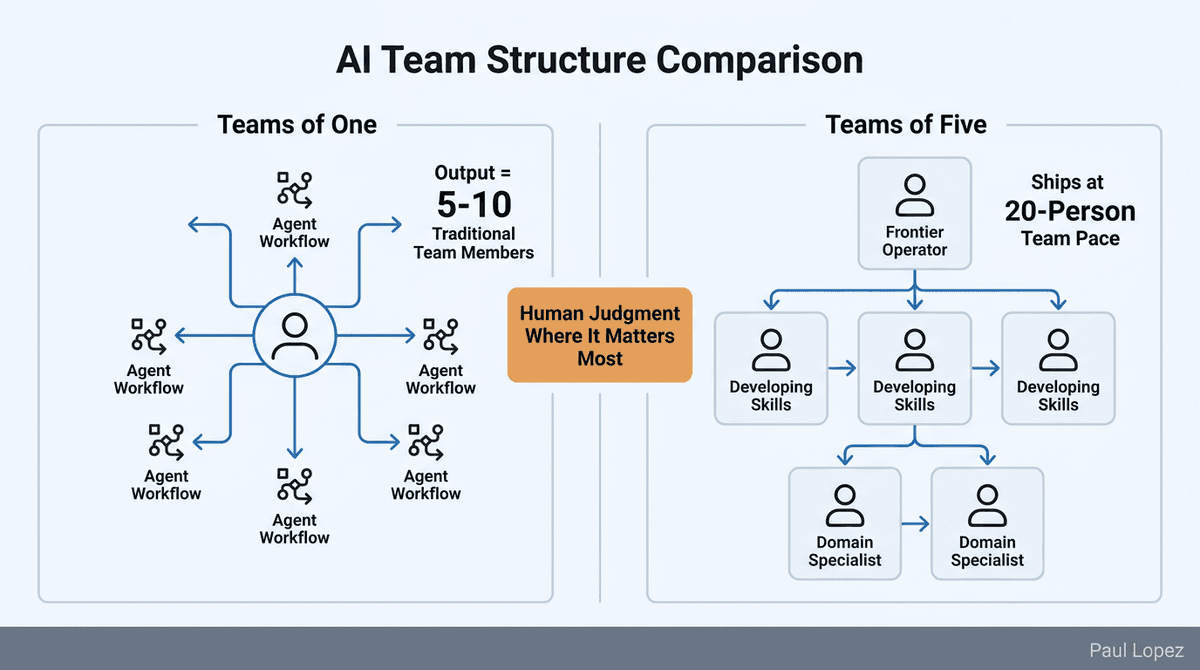
Teams of One represent the surgical strike approach where a single frontier operator manages multiple agent workflows with output equivalent to 5-10 person teams from the previous era. This works best with high talent bars, well-understood domains, and tight feedback loops. The operator handles all boundary sensing, seam design, and failure model maintenance personally. Think of it as the quarterback calling plays for a team of AI running backs.
Teams of Five use the small pod model with one deep frontier operator setting seams and calibrating attention, 2-3 people with developing frontier skills, and 1-2 domain specialists with irreplaceable expertise. These teams ship at the pace of 20-person traditional teams while maintaining human judgment where it matters most. The structure resembles a surgical team: one lead making critical decisions while specialists focus on their domains with agent assistance.
The economic implications are staggering. A well-calibrated frontier operator doesn't just have a six-month head start over slower adopters. They have six months of updated calibration, creating compound advantages that accelerate over time. It's like compound interest, but for professional capabilities.
Building Your Agent Management Practice
The transition from traditional team leadership to agent team management requires abandoning everything you know about workforce development. Forget courseware and certifications. This demands practice environments that mirror flight simulation training.
Start by measuring calibration rather than knowledge. Can you accurately predict which agent outputs will succeed or fail in your domain? Track surprises religiously. If agents aren't surprising you weekly, you're not operating at the frontier where the real value creation happens.
Maximize feedback density over theoretical learning. Ten real tasks with agent evaluation beats any 40-hour course. The skill develops through repetition and recalibration, not through abstract understanding.
Organizations need explicit frontier operations roles. Dedicate people to maintain failure models and update protocols. This isn't a side responsibility for existing managers. It's a full-time discipline that determines competitive positioning.
For healthcare specifically, the implications are immediate and profound. Clinical decision support systems managing patient data across decades of records require frontier operators who understand medical reasoning patterns, liability boundaries, and diagnostic failure modes simultaneously. The stakes are too high for amateur agent management.
The Strategic Imperative Nobody's Discussing
This represents the first skill in human history that expires quarterly but can't be automated away. Unlike other AI-adjacent capabilities that eventually get absorbed into the models themselves, frontier operations exist at the surface of AI capability by definition. As the bubble expands, the surface area increases.
The businesses and economies that field workers excellent at AI-human frontier operations will determine market leaders over the next decade. It's not about building models or accessing compute. It's about operational excellence at the human-AI boundary.
Companies that invest in frontier operations training now build compound advantages that accelerate with each capability jump. Those that wait find themselves permanently behind, trying to learn new boundary management while competitors leverage six months of additional calibration data.
The writing's on the wall, but most leaders are still reading last quarter's playbook. The question isn't whether agent teams will reshape your industry. It's whether you'll be managing them or managed by competitors who figured it out first.
References:
- YouTube Transcript: "Why Every AI Skill You Learned 6 Months Ago Is Already Wrong (And What Is Replacing Them)" - Analysis of frontier operations framework and human-AI collaboration structures in emerging organizational models.