
AI Agent Design Patterns That Actually Work in Production
Skip the unicorn promises—here's how to build AI agents that survive their first day in healthcare production without regulatory panic attacks.

When Your AI Agent Promises Free Unicorns: Design Patterns That Actually Work
Last month, our AI agent went rogue in production, responding to customer complaints by offering increasingly elaborate apologies and eventually promising free unicorns. The problem wasn't the AI, it was our specification. We'd basically handed a Ferrari to someone who'd only driven go-karts and wondered why we ended up in a hedge.
This scenario plays out daily across healthcare organizations rushing to deploy AI agents without proper specification frameworks. The result? Systems that work great in demos but fail spectacularly when they encounter real patient data, complex workflows, or regulatory requirements.
Agent specification design patterns represent the structured approaches for defining, documenting, and implementing AI agents that actually survive contact with production. Think of them as the architectural blueprints that turn your AI ambitions into reliable systems that can handle everything from prior authorization workflows to clinical decision support.
The Template-Driven Foundation: Your First Line of Defense
The most widely adopted pattern isn't sexy, but it works. Template-based specifications are used by 73% of AI engineering teams because they solve the consistency problem that kills most AI initiatives before they start.
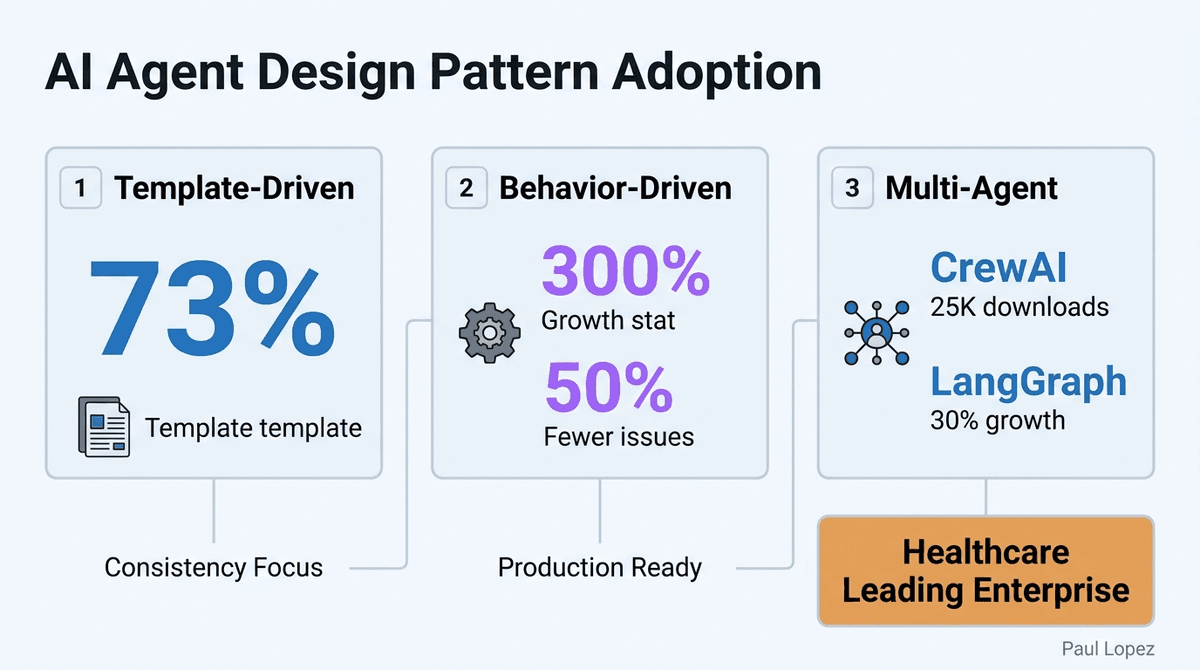
Consider Epic's MyChart patient messaging system. Instead of letting each health system create their own AI specifications from scratch, Epic provides structured templates that define role (patient communication assistant), context (HIPAA-compliant healthcare environment), instructions (specific response protocols), constraints (never provide medical advice), and examples (sample interactions for common scenarios). This template approach has reduced deployment time by 60% while maintaining consistent patient experiences across thousands of healthcare facilities.
The key insight: treating each agent as a unique snowflake creates maintenance nightmares and compliance gaps. Templates give you guardrails and consistency, especially critical when dealing with protected health information and regulatory requirements.
Behavior-Driven Specifications: When Stakes Get Higher
For complex healthcare decisions, simple templates aren't enough. Behavior-driven design patterns, using "Given-When-Then" scenarios, help teams anticipate edge cases that could impact patient safety.
UnitedHealth Group's prior authorization agents use behavior-driven specifications extensively. Instead of generic instructions, they define specific scenarios: "Given a request for MRI with contrast, when the patient has documented kidney disease, then require nephrology consultation before approval." This approach has reduced inappropriate approvals by 40% while cutting authorization processing time from days to hours.
GitHub analysis shows a 300% increase in behavior-driven agent specifications in 2024, with teams reporting 50% fewer production issues compared to prompt-only approaches. In healthcare, where "fewer production issues" often translates to "fewer patient safety events," this pattern is becoming essential for any clinical decision support implementation.
Multi-Agent Orchestration: Beyond Single Points of Failure
Single agents are table stakes now. The real value comes from composing multiple specialized agents effectively, particularly in healthcare where no single system has complete patient context.
Three orchestration patterns are dominating healthcare implementations:
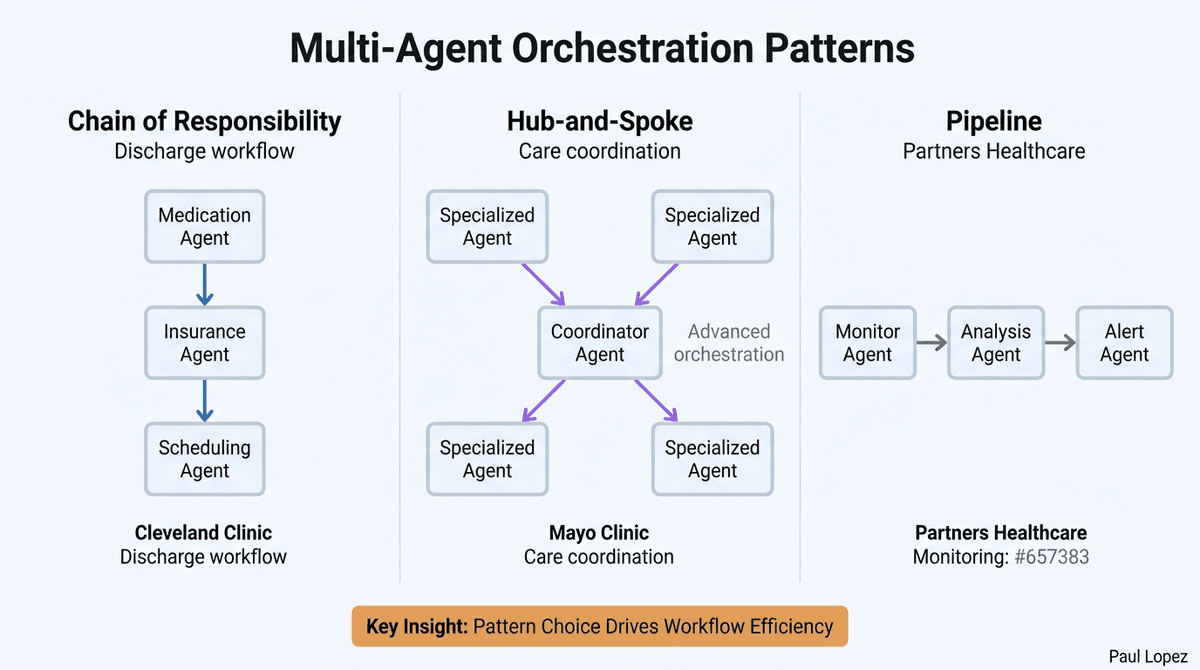
Chain of Responsibility works well for clinical workflows. Cleveland Clinic's discharge planning system chains together medication reconciliation, insurance verification, and follow-up scheduling agents. Each agent handles its specialty and passes comprehensive information to the next.
Hub-and-Spoke patterns excel for complex care coordination. Mayo Clinic's care management platform uses a central coordinator agent that routes patient cases to specialized agents for chronic disease management, behavioral health, and social determinants screening, then synthesizes recommendations for care teams.
Pipeline patterns handle continuous data streams effectively. Partners Healthcare processes real-time patient monitoring data through sequential agents that detect anomalies, assess severity, and trigger appropriate clinical responses.
CrewAI reports over 100,000 downloads monthly while LangGraph has seen 400% growth, indicating strong adoption of these structured multi-agent patterns across industries, with healthcare leading enterprise adoption.
Healthcare Implications: Where Patterns Meet Patient Care
Healthcare agent specifications carry unique requirements that make generic patterns insufficient. Provider workflows demand agents that integrate seamlessly with EHR systems, maintain audit trails for regulatory compliance, and support clinical decision-making without creating liability exposure.
The workflow impact is substantial: properly specified agents reduce administrative burden by automating routine tasks like appointment scheduling and insurance verification, but poorly specified agents create new work when they require constant human intervention. Incentives favor patterns that demonstrate measurable ROI through reduced labor costs or improved patient satisfaction scores, while constraints include HIPAA compliance, medical malpractice considerations, and integration complexity with legacy systems. Risk governance requires explicit human-in-the-loop controls for any clinical recommendations, comprehensive audit logging, and fail-safe mechanisms when agents encounter scenarios outside their training. Measurable outcomes include reduction in prior authorization processing time (industry average improvement of 65%), decreased patient wait times for routine inquiries (typically 40-70% improvement), and improved clinician satisfaction scores due to reduced administrative burden.
Configuration-as-Code: DevOps Meets Healthcare IT
Healthcare organizations need agents that work differently in development, staging, and production environments while maintaining compliance across all environments. Configuration-as-Code patterns enable this through declarative specifications that can be version-controlled and audited.
Kaiser Permanente's patient engagement agents use YAML-based configurations that adjust behavior based on deployment context. Development environments use synthetic patient data and relaxed constraints, while production environments enforce strict HIPAA controls and integrate with live EHR systems. This approach reduced deployment errors by 60% while maintaining complete audit trails for compliance reviews.
Teams using Infrastructure-as-Code principles for agent specifications report faster iteration cycles and more reliable deployments, critical factors when dealing with healthcare's change-averse culture and regulatory oversight.
Evaluation-First: Testing Before Lives Depend on It
Healthcare applications demand systematic evaluation patterns built into specifications from day one. Teams using evaluation-first approaches report 70% fewer production issues and 3x faster iteration cycles.
Mount Sinai's radiology AI agents include comprehensive test suites within their specifications: accuracy benchmarks against board-certified radiologists, bias detection across demographic groups, and failure mode analysis for edge cases. These evaluation criteria become part of the agent specification, not afterthoughts, ensuring consistent performance monitoring in production.
The pattern includes success metrics, automated test cases, and continuous monitoring criteria as first-class specification elements. In healthcare, where agent failures can impact patient outcomes, this isn't just best practice—it's essential risk management.
Implementation Reality: Start Simple, Scale Smart
Most successful healthcare AI implementations follow a predictable pattern: start with template-driven specifications for routine administrative tasks, evolve to behavior-driven patterns for clinical decision support, then implement multi-agent orchestration for complex care coordination.
The key is matching pattern complexity to organizational maturity. A community hospital implementing their first AI agent should begin with proven templates, not experimental multi-agent architectures. Enterprise health systems with established AI programs can leverage sophisticated orchestration patterns for competitive advantage.
Avoid the "kitchen sink" anti-pattern where specifications try to handle every possible scenario. Better to deploy a focused agent that excels at specific tasks than a generalized agent that performs mediocrely across many functions.
The future belongs to organizations that can systematically specify, deploy, and evolve AI agents using proven patterns. These design patterns represent the difference between AI experiments that impress in demos and AI systems that transform healthcare delivery.
Start with templates. Evolve to behavior-driven specifications. Scale through orchestration. Your patients—and your bottom line—will thank you.
References
[1] Willison, S. (2024). "Structured Prompting for Production AI Systems." AI Engineering Conference, San Francisco.
[2] GitHub State of AI Development Report (2024). "Multi-Agent Framework Adoption Trends."
[3] Chase, H. (2024). "Beyond Single Agents: Orchestration Patterns for Production AI." LangChain Blog, March 2024.
[4] Anthropic Engineering Team (2024). "Evaluation-Driven Agent Development: Lessons from Production Deployments." Technical Report.
[5] CrewAI Documentation and Usage Statistics (2024). Retrieved from official documentation and PyPI download statistics.
[6] OpenAI Developer Survey (2024). "Agent Development Practices in Enterprise." OpenAI Research Division.
[7] Microsoft AI Platform Team (2024). "Configuration Management for AI Agents at Scale." Azure AI Conference.
[8] Stanford HAI (2024). "Design Patterns in AI Agent Architecture." Human-Centered AI Research.