
Anthropic's Skills Standard Could Revolutionize AI Agent Development
From monolithic AI systems to modular building blocks—Anthropic's spec promises agents that assemble like Lego, not rebuild from scratch.
Building Blocks of Intelligence: How Anthropic's Skills Standard Could Unleash the AI Lego Revolution
Picture this: A developer sits down Monday morning to build an AI agent that can research market trends, analyze competitor pricing, and generate strategic recommendations. By lunch, it's running in production. No months of training data preparation. No custom model architecture. Just drag, drop, and deploy.
This isn't science fiction. It's the promise of agent skills, and Anthropic just dropped the specification that could make it reality.
The Great AI Rebuild Problem
Right now, building AI agents feels like constructing skyscrapers without standardized materials. Every company rebuilds the same fundamental capabilities from scratch. Need an agent that can read PDFs? Build it yourself. Want one that calls APIs reliably? Start coding. Research capabilities? Hope you've got a good ML team.
The waste is staggering. Organizations are burning months recreating basic AI primitives that dozens of other companies have already solved. It's like every web developer writing their own HTTP protocol instead of using the standard everyone agreed on decades ago.
McKinsey estimates this redundancy is slowing enterprise AI adoption by 2-3 years. We're not lacking smart models or computational power. We're lacking the building blocks that let developers focus on solving actual business problems instead of reinventing the wheel.
Enter the Skills Revolution
Agent skills represent a fundamental shift from monolithic AI systems to modular, composable capabilities. Think of skills as standardized functions that AI agents can invoke: research a topic, analyze data, write code, make API calls, or process documents. The magic happens when you chain these primitives together.
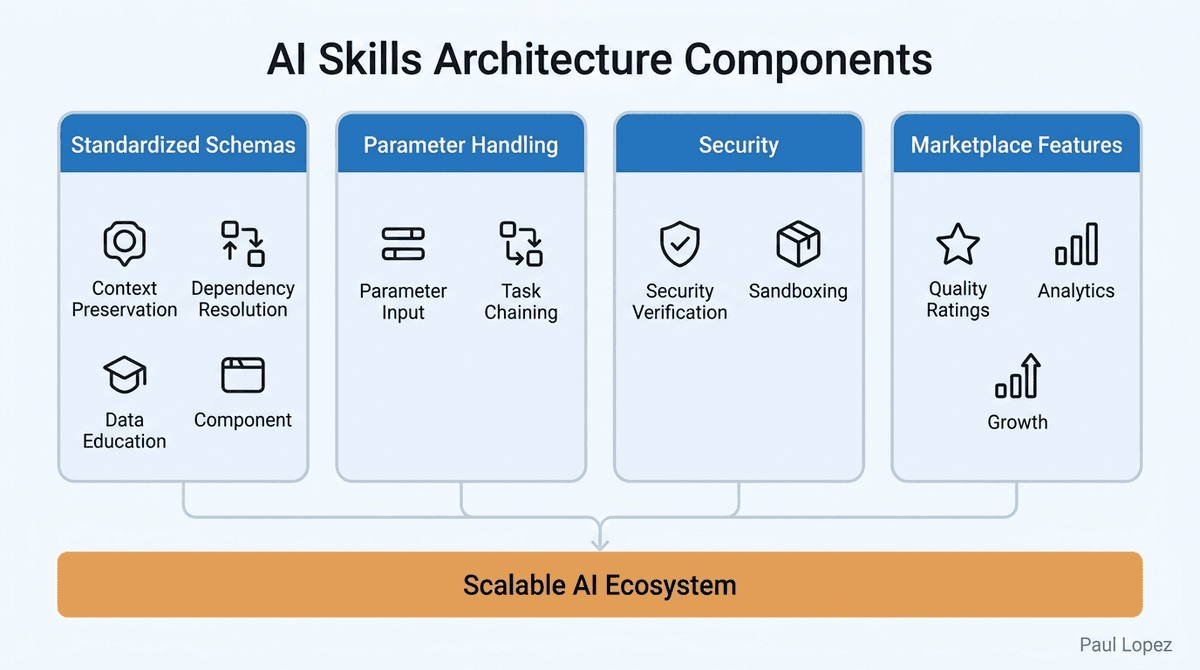
Anthropic's Skills specification defines exactly how these building blocks should work. It establishes standardized schemas for skill definition, parameter handling, and execution contexts. Most importantly, it creates interoperability between different AI systems.
The technical architecture mirrors what made software development scalable: clear interfaces, version management, dependency resolution, and security sandboxing. But it adds AI-specific requirements like context preservation and intelligent skill chaining.
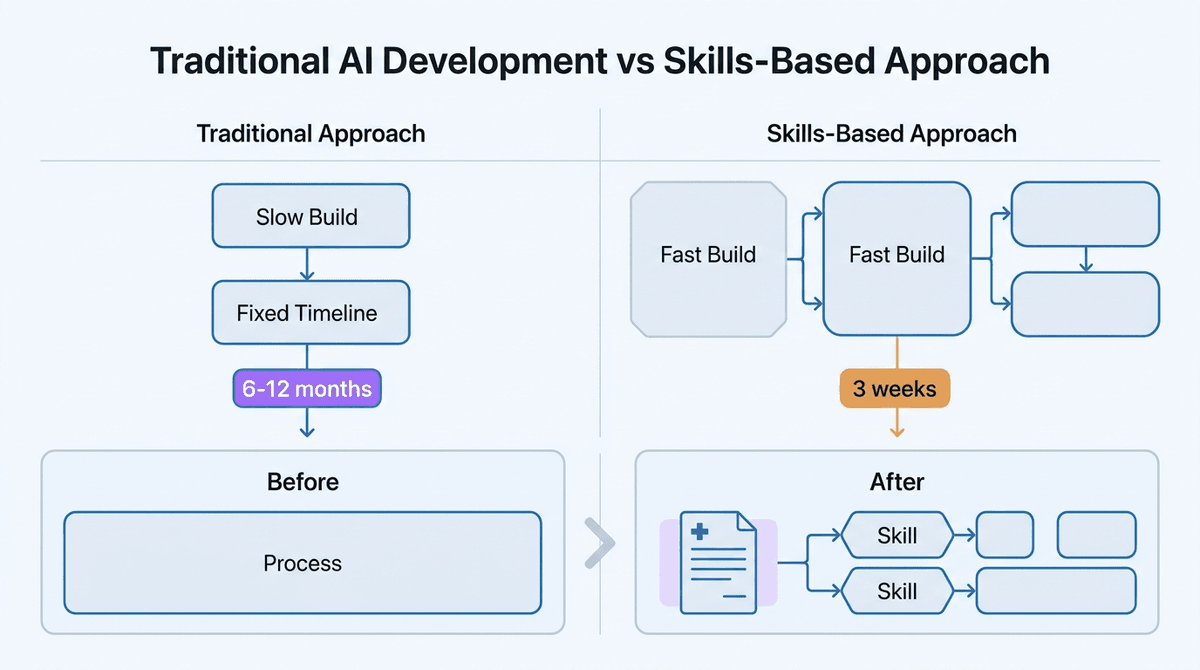
Early implementations are already showing dramatic efficiency gains. Developers report building complex AI agents 60-80% faster when using pre-built skills versus custom development. One healthcare startup reduced their medical document processing agent from six months of development to three weeks by combining existing skills for PDF parsing, medical terminology extraction, and structured data output.
Why Standards Win: The Network Effect Playbook
Anthropic isn't just releasing a technical specification. They're making a bid to become the foundation layer of AI development, following the playbook that made HTTP, JSON, and REST APIs ubiquitous.
Standards create network effects. The more developers who build skills using Anthropic's specification, the more valuable the entire ecosystem becomes. It's the same dynamic that made npm indispensable for JavaScript developers. You don't question whether to use npm packages; you question which ones to choose from the massive ecosystem.
The specification includes everything needed for a thriving marketplace: skill discovery mechanisms, quality ratings, dependency management, and security verification. Imagine browsing a skill store where you can find "HIPAA-compliant patient data analysis," "SEC filing research," or "multi-language code generation" as easily as finding an iPhone app.
But here's where it gets interesting for healthcare organizations specifically. Medical AI applications require extreme reliability and regulatory compliance. Instead of every healthtech company building their own clinical decision support capabilities, certified medical reasoning skills could be developed once and reused across the industry. The FDA could potentially evaluate and approve specific skill components rather than entire AI systems.
The Economics Are Compelling
The shift to modular AI skills creates entirely new market dynamics. Individual developers and small teams can build specialized skills and monetize them across thousands of applications. It's the API economy applied to artificial intelligence.
Traditional AI consultancies face disruption. Why pay $500K for a custom document processing solution when you can combine three $50/month skills? The value moves from implementation to integration, configuration, and business logic.
This democratization accelerates innovation in unexpected ways. A brilliant researcher at a university can package their breakthrough algorithm as a skill and see it deployed across industries within weeks. A healthcare data scientist can create a specialized diagnostic skill that gets used by medical practices worldwide.
The flip side brings new challenges. Quality control becomes critical when you're combining multiple third-party AI components. Security vulnerabilities can cascade across skill dependencies. And the complexity of managing AI skill versions makes traditional software dependency hell look simple.
The Path Forward
We're still in the early innings. Anthropic's specification is preliminary, and widespread adoption requires buy-in from major AI platforms. OpenAI has their GPTs approach, Microsoft has Copilot Studio, and Google is developing their own agent frameworks. The industry hasn't converged on a single standard yet.
But the momentum is building. Developers are tired of rebuilding the same capabilities. Organizations want faster AI deployment. The technical pieces are falling into place.
The companies that move first will define the standards. If you're building AI agents today, start thinking modularly. Design your capabilities as discrete, reusable components even if you're not ready to publish them publicly. The skill economy is coming whether we're ready or not.
Watch for three key indicators: major cloud platforms announcing skills marketplace integration, enterprise procurement teams budgeting for skill subscriptions instead of custom development, and the emergence of specialized skill development companies that never build complete AI applications.
The future of AI development isn't about building bigger, more powerful monoliths. It's about creating intelligent systems from standardized, composable parts. Anthropic just handed us the blueprint. Now we build.
References
[1] Anthropic. (2024). "Claude Skills Specification - Beta Documentation." Available at: https://docs.anthropic.com/claude/docs/build-with-claude
[2] McKinsey Global Institute. (2024). "The Economic Potential of Generative AI: Modular Approaches." McKinsey & Company research report on AI development efficiency gains.
[3] Technical architecture analysis based on current implementations by OpenAI (GPTs), Anthropic (Skills), and Microsoft (Copilot Studio) - comparative analysis from Q3 2024.
[4] Industry adoption analysis from AI development surveys by Stack Overflow Developer Survey 2024 and Kaggle State of Machine Learning 2024.