
Typed Answers Can Still Be Catastrophically Wrong
When your AI gives you a perfectly formatted wrong answer, the schema won't save you—only your threshold will.

A Typed Answer Is Not a Correct Answer
Bounded decision models like Jev remove an entire class of failure and quietly relocate the one that matters, from the output format to the decision threshold.
Every routing, scoring, and escalation decision inside an agent loop is currently a full LLM call. That means token generation, latency, parsing logic, and a non-trivial chance that the output field you needed arrives malformed, hallucinated, or simply absent. For teams running agentic workflows at scale, those decisions are the hidden tax on every operation, and the bill compounds fast.
TypeSafe AI launched Jev on September 15, 2026, after two years in stealth and a $40 million seed round led by DCVC. The claim it shipped with was stark: up to 193.6x faster and 444.6x cheaper than LLMs on its own workflow evaluations. Within 24 hours of availability on Vercel AI Gateway, nearly 13 percent of Vercel's paid teams were already using it. That is more than twice the adoption share of any previous model launch on that platform.
Jev is a real advance that removes a real failure mode, and the word attached to it, "type-safe," is about to be misread by the people who most need to read it correctly.
What Jev Actually Is
Seinfeld fans will remember the "yada yada" episode. George's girlfriend tells a story, skips directly over the part that actually happened, and keeps going as if the narrative is complete. Elaine calls it: "You yada yada'd over the best part." The story was grammatically whole. Nothing in its structure revealed that the substance was missing. The form was fine. The content was gone.
A typed decision works the same way. The answer conforms to the schema. The schema says nothing about whether the evidence warranted it.
Jev is a decision model, not a writer. You give it state, which is the evidence, and a question whose answers you have defined in advance. It returns one of those answers with a probability, and your application code decides what to do with it. It does not produce prose, it does not produce code, and it does not invent an option you did not offer. The answer it gives is always a valid member of the set you specified.
That is the whole point, and it is a good one. The dominant way teams have used generative models for decisions is to ask an eloquent writer to also be a reliable switch. You prompt for a routing choice, parse the free text or the structured output, and hope the field you needed is present, valid, and not hallucinated. Jev removes that hope from the loop. The decision comes back typed, bounded, and inspectable, with the probability distributed across the options you allowed.
TypeSafe calls this category a "System One" model, a name drawn from Daniel Kahneman's Thinking, Fast and Slow. System 1 thinking is fast and intuitive. System 2 is slower and deliberate. The framing is intentional: Jev is not a reasoning engine. It is built for bounded judgments where the answer set is known and the value of the output is speed, structure, and confidence.
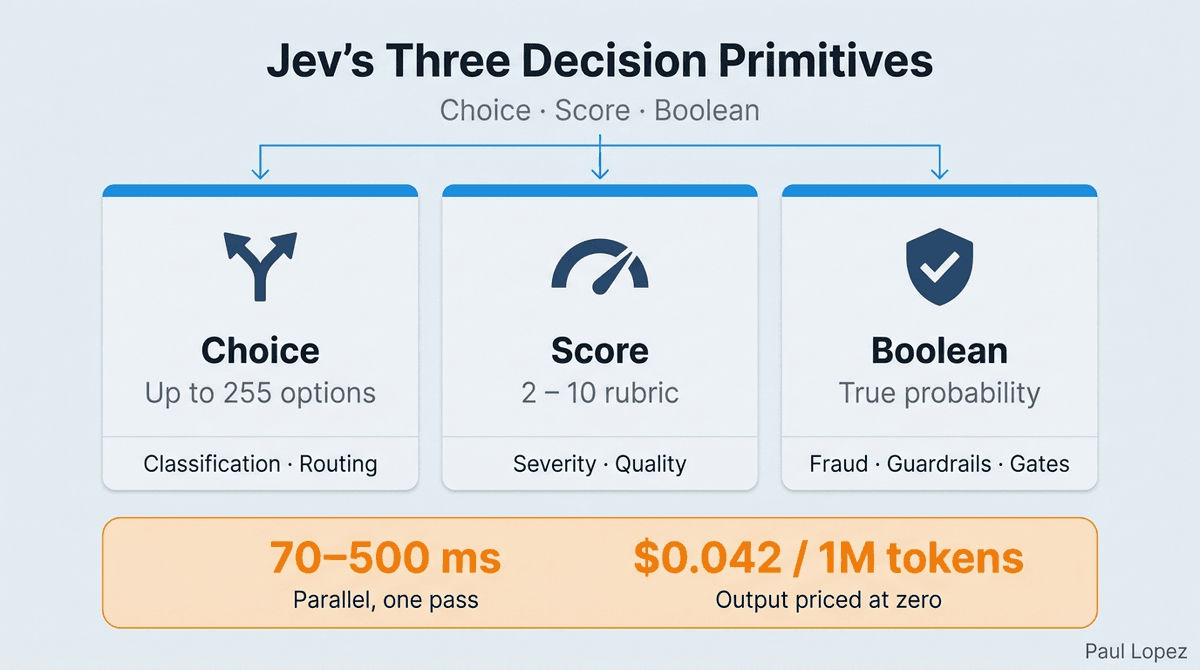
The three primitives are Choice, Score, and Boolean. Choice selects one of up to 255 named options, which covers most classification problems a routing workflow will encounter. Score places an assessment on an ordered rubric from 2 to 10, useful for severity grading or quality evaluation. Boolean returns a probability of true, a yes-or-no confidence suited for fraud checks, guardrail verification, or escalation gates. All questions submitted in a single call are evaluated in parallel, with answers returned in one pass between 70 and 500 milliseconds, at $0.042 per million input tokens with output priced at zero.
The feature that makes this primitive governable is the inspectable trace. Jev does not just return an answer; it returns a probability distribution across the allowed options. An answer of "billing" with 0.71 probability and "technical" at 0.24 tells a reviewer something a single label never could. Keep the evidence, the question, the allowed answers, the proposed answer, and the distribution together, and you have a record a human can interrogate and a system can replay. That trace is the governance artifact. Without it, a label is just a fact with no address.
Why This Matters for Regulated Decisioning
For a bank, an insurer, or a fintech, a large share of AI value is not writing at all. It is deciding. Which team owns this incident, which queue this claim belongs in, whether this transaction pattern trips a review, how disruptive this outage is on a defined rubric. These are bounded decisions with a right shape and a definable set of answers, and they are exactly what a decision model is built to return.
The governance win is the inspectable trace. A typed decision carries its evidence, its question, its allowed answers, and a probability across those answers, which means the record a reviewer needs already exists in the shape they need it. You set a threshold that balances the cost of a wrong assignment against the cost of human review, and the decisions below it route to a person. That is a far better starting point for an audited workflow than a paragraph of model prose that a downstream system has to interpret and cannot easily replay.
The threshold is where the regulated use case gets practical. In claims triage, a Boolean question about whether a claim matches a known fraud pattern returns a probability. You decide whether 0.85 is the line for automatic referral to the fraud queue or whether 0.92 is safer given the cost of a false positive. In AML screening, a Choice across transaction categories returns a distribution that tells you not just the classification but how close the alternatives were. A Score on a severity rubric gives a risk function a number it can compare across decisions and audit across time. These are control surfaces. They can be set, monitored, and adjusted, which is what a risk team needs before it will sign off on automation.
The threshold and the trace make decisioning auditable. Neither one certifies that the answer is correct.
That gap is a design choice, not a product gap. The workflow owns the quality bar. The evaluation discipline that closes the gap between a typed answer and a reliable one belongs to the team deploying the model, not to the model itself.
The Trap: "Type-Safe" Will Be Heard as "Correct"
Here is the sentence that will cause the trouble, and TypeSafe says it plainly: a typed answer conforms to the schema, and conforming to the schema does not make the decision correct. An answer of "payments" is perfectly valid even when a broken storefront script is the real cause, and the well-formed answer sends the investigation to the wrong team with a confident number attached.
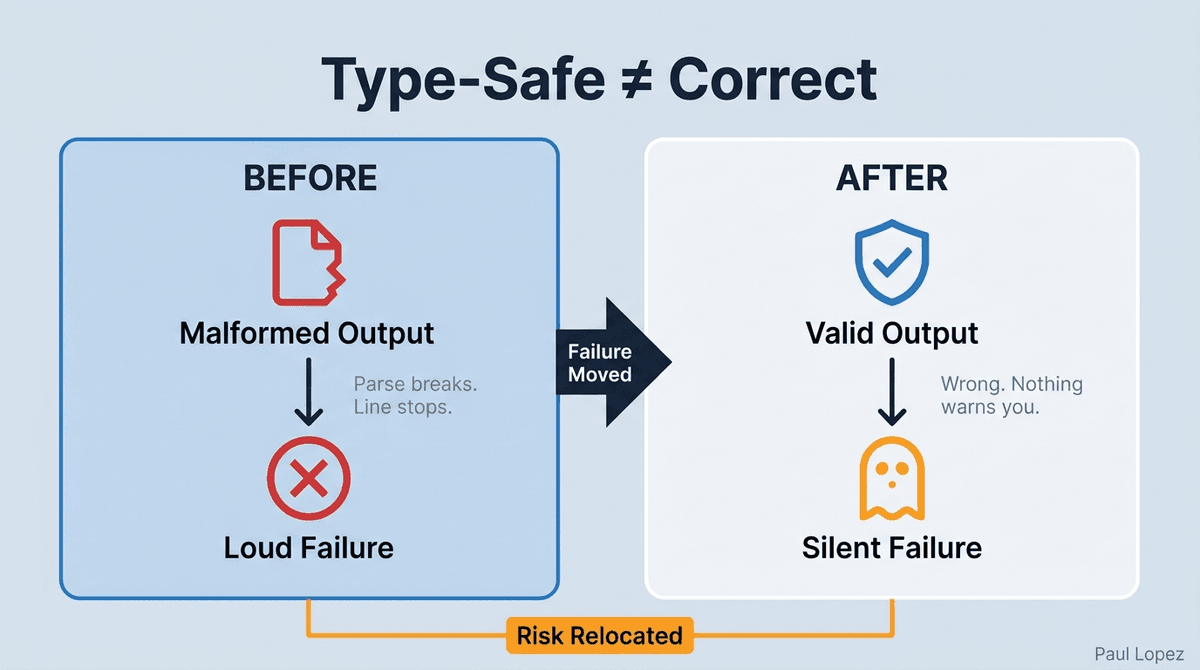
The danger is linguistic before it is technical. "Type-safe" is a precise claim on an engineer's desk and a much larger one by the time it reaches the executive who signs off on automating a decision. Type safety guarantees that the answer is a legal value. It says nothing about whether the evidence supported that value, and a probability is not a proof. The old failure mode was loud: malformed output that broke the parse and stopped the line. The new failure mode is quiet: a clean, valid, plausible answer that is simply wrong, and nothing about its form will warn you.
Type safety moved the failure, it did not retire it.
The mitigation is exactly the work the trace and the threshold make possible, and it has to happen before automation. Evaluate Jev's typed decisions against resolved cases from your own domain: closed incidents, settled claims, cleared transactions. Deliberately include the hard examples, the ones with ambiguous ownership, thin evidence, and contested outcomes. Then set your confidence threshold against the real cost of a wrong call in your context, not against an abstract accuracy number. A threshold of 0.90 for auto-routing a support ticket is a different calibration than 0.90 for routing a suspected fraud case. The number looks the same. The consequence of being wrong does not.
The design rule TypeSafe's own guidance makes explicit is worth stating plainly. Selecting an owner or a route should never quietly acquire the authority to execute a consequential action. Policy and execution stay in application code. The model proposes; the application checks permissions, validates arguments, and acts. Where the cost of error is highest, a human checkpoint sits between the proposed answer and the action. Jev gives you a number, not a rationale. The rationale is your threshold, your evidence standard, and the resolved cases you used to set both.
The parallel to earlier decision systems that got this right is instructive. The ones that aged well were the ones where confidence was computed from the relationship between the evidence and the outcome, measured against resolved cases before any automation was trusted. The number the model reported about itself was a starting point, not a verdict.
Jev will never yada-yada the format. It can absolutely yada-yada the evidence, and the answer will look just as clean either way.
The Honest Counterargument
The fair objection is that this undersells Jev. Bounded answers, an inspectable trace, and a probability you can threshold are not obstacles to evaluation. They are what finally makes evaluation practical. Compared with grading a paragraph of free-text reasoning, scoring a typed decision against a known outcome is straightforward, and that is a real step forward.
That objection is correct, and it sharpens the point rather than blunting it. Jev makes the right discipline cheaper, more inspectable, and easier to automate, which is precisely why it deserves to be adopted. The warning was never about the tool. It was about the word. A primitive that makes evaluation easy is wasted if the organization concludes, from the phrase "type-safe," that evaluation is no longer necessary. The better the decision model, the more important it becomes to remember what its guarantee does and does not cover.
Where to Start
The practical entry point is one bounded decision you already review manually, with a labeled set of resolved outcomes you can score against. Pick an incident routing classification, a claims queue assignment, or a severity grade on a rubric your team already uses. Run Jev's typed output against those outcomes before you automate anything. Set your threshold conservatively, higher than feels necessary, and route the uncertain cases to a person. Watch whether the distribution tells you something the single label would have hidden.
Jev is available today through Vercel AI Gateway without a waitlist. Anyone with a Vercel account can reach it using AI SDK 7's experimental evaluate API at typesafe-ai/jev. Zero Data Retention and no-training options are available per request, which matters in regulated environments. Vercel, Cloudflare, LangChain, and Langfuse all integrated within three days of launch, so the ecosystem support is already in place.
The firms that will benefit from this shift are the ones that understood the distinction from the start: type safety is a guarantee about the shape of an answer, and correctness is still earned through evaluation, a chosen threshold, and the willingness to keep reviewing decisions even after the format stopped being the problem. The quiet failure hides in exactly the place a clean answer tells you not to look.